


 Oops! We couldn’t find any results...


Leadership
3 IPOs in the rearview mirror with 35+ years of executive experience
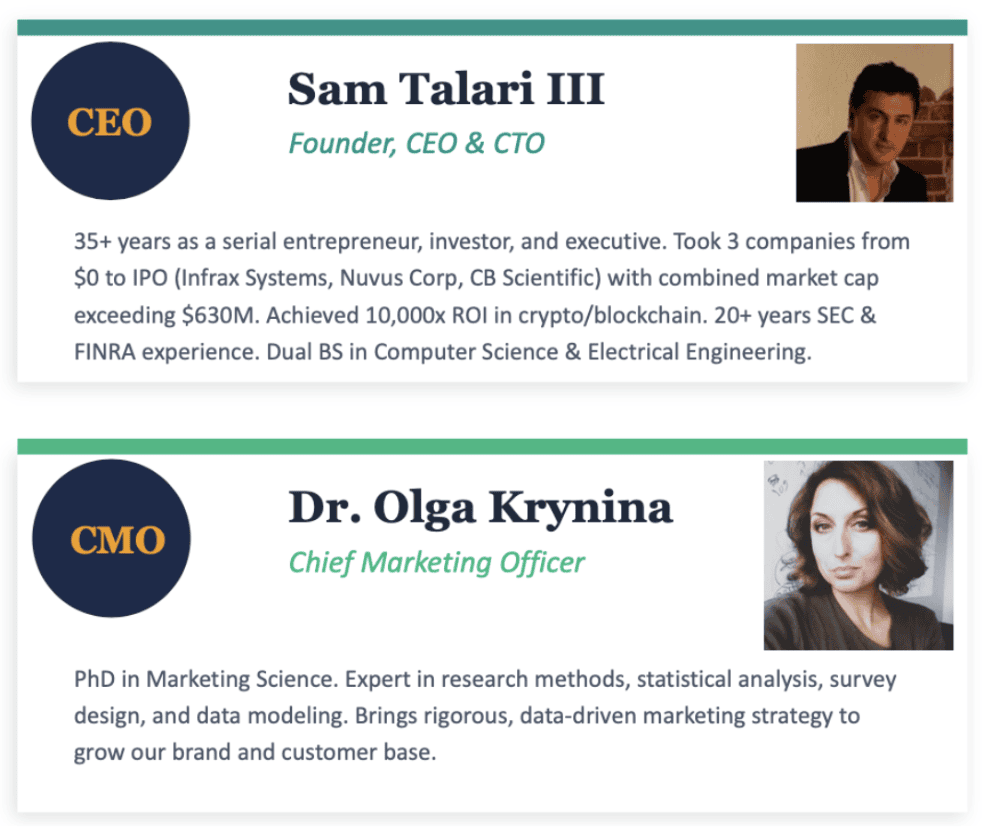
Mintworks is led by CEO/CTO Sam Talari III, who brings over 35 years of entrepreneurial and executive experience. He’s taken three companies from zero to IPO (Infrax Systems, Nuvus Corp, CB Scientific) with a combined peak market cap exceeding $630 million. He also brings over 20 years of SEC and FINRA experience.
Opportunity
Tokenization could become a $30 trillion opportunity by 2030
Trillions of dollars across bonds, equities, real estate funds, and other asset classes are locked inside slow, expensive legacy systems that exclude most of the world’s population. Many companies, especially small- and medium-sized businesses, have no way to offer assets within this system.
Enter digital ownership, which is quickly gaining institutional momentum. Projections for this market could reach up to $30 trillion by the early 2030s according to British multinational bank, Standard Chartered.
Favorable regulatory developments across the U.S., Europe, and Asia are accelerating the shift. Major institutions like BlackRock, JPMorgan, and Goldman Sachs are already building in this space, validating the market direction.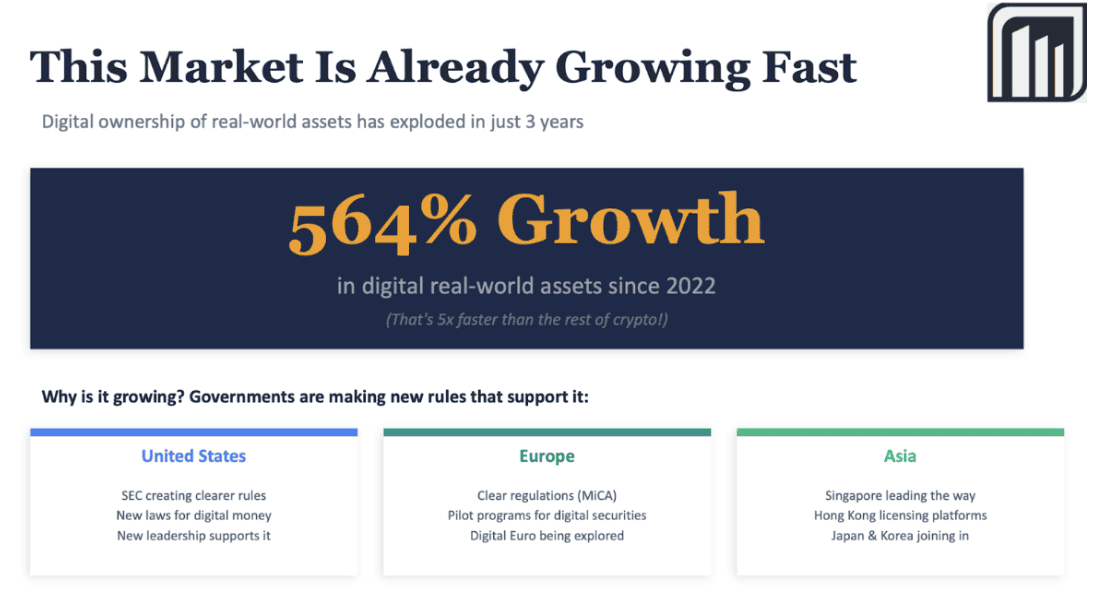
Problem
Most investors are priced out of prime opportunities
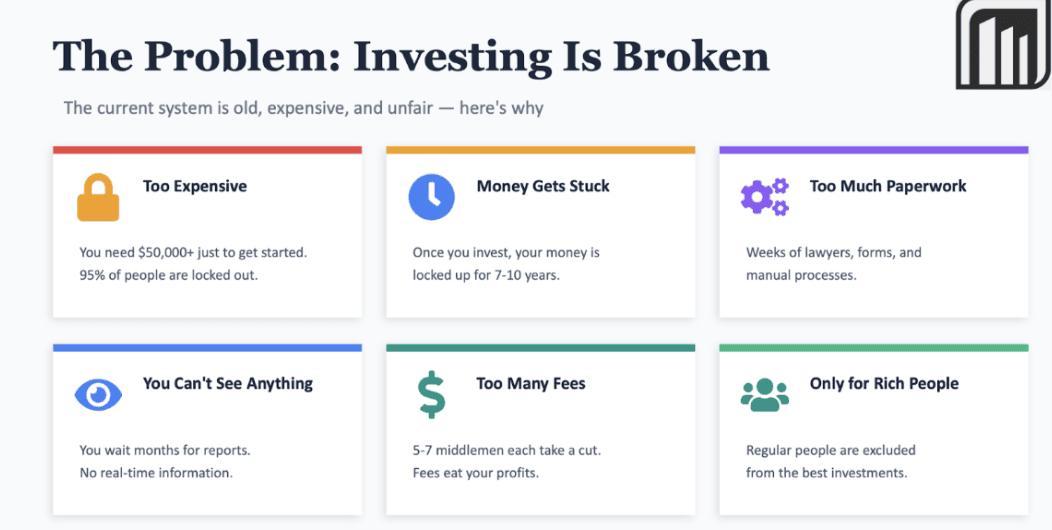
Traditional investing is broken in several interconnected ways:
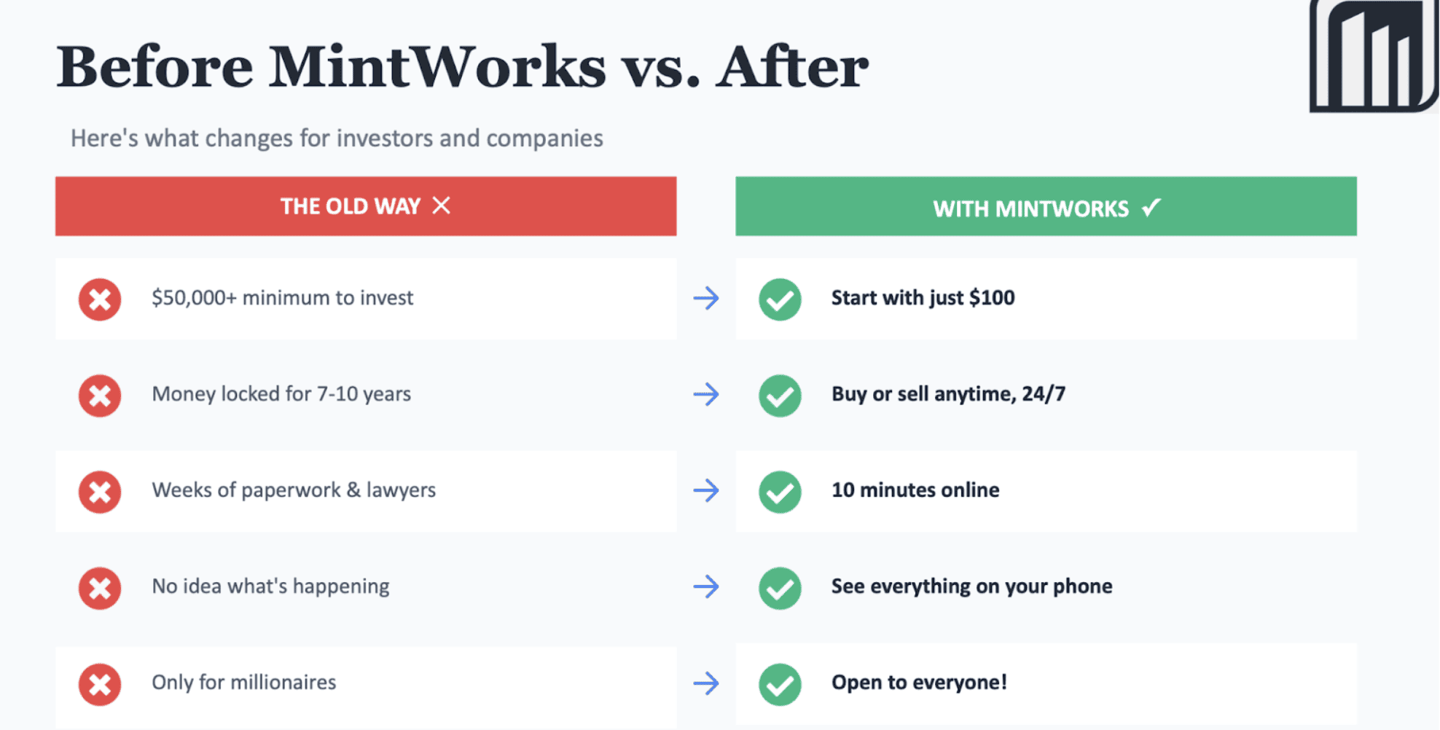
High minimum investments (often $50,000+) lock out roughly 95% of would-be participants
Once committed, capital is typically illiquid for up to 10 years
Weeks of legal paperwork are required
Multiple middlemen extract fees
Little to no transparency for investors waiting months for basic updates
The infrastructure is outdated, expensive, and structurally biased toward institutions and wealthy investors, leaving the majority of people unable to participate in investments that build generational wealth.
Solution
Real-world asset platform lets companies tokenize any asset for just $100
MintWorks’ software lets any company convert real-world assets into fractional digital shares that can be bought, sold, and tracked online, starting at $100.
Their holistic platform handles:
Legal setup and share creation to KYC/AML compliance
Automated profit distribution
Secondary market trading
Mintworks works across over 5 blockchain networks and integrates with major players in custody, stablecoins, and brokerage. The platform is designed to serve the full market, from small fund managers to large banks, under one unified, compliance-embedded platform.
Growth Plan
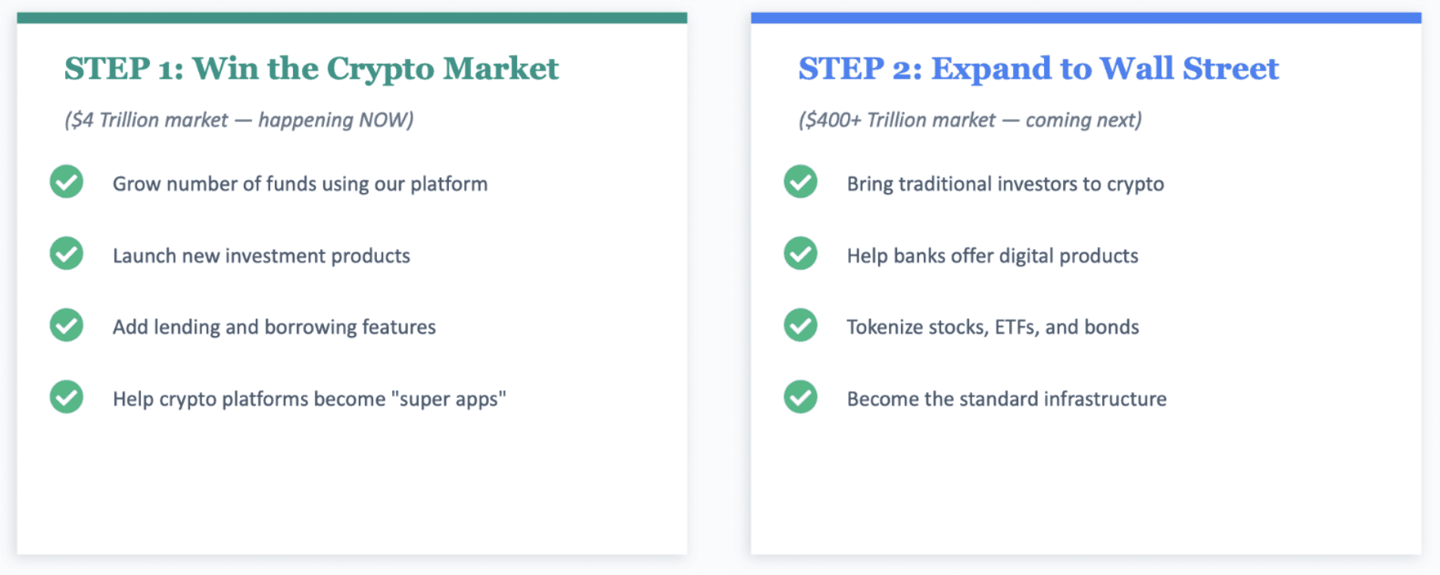
Win in Crypto, expand to Wall Street
MintWorks has a clear roadmap: start with companies that understand the value of cryptocurrency, then expand to traditional businesses that realize the potential for growth in digital assets.
Business model
Diversified revenue streams leading to a projected $320 million in revenue in four years
MintWorks generates revenue through four complementary streams:
One-time setup fees when clients onboard
Recurring monthly SaaS subscription fees
Percentage of assets under management
Smaller service fees for payments, tax reporting, and investor tools
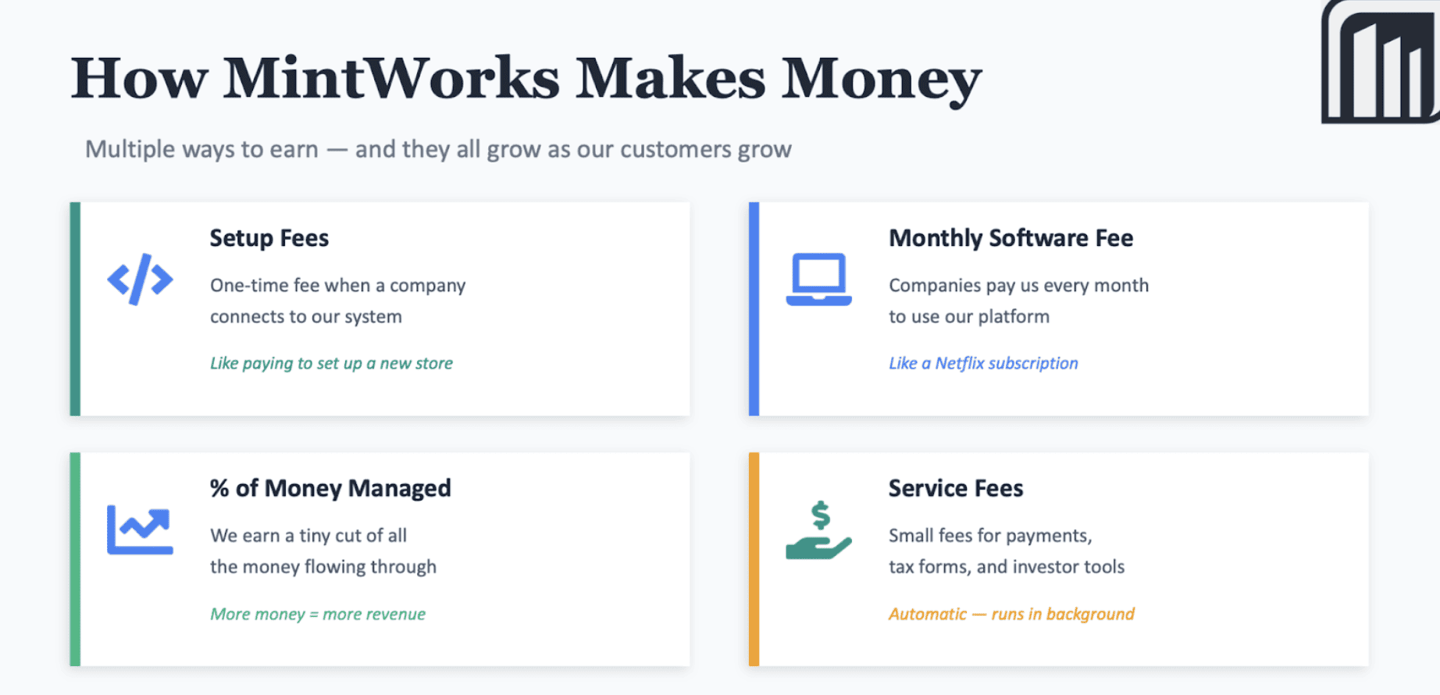
This diversified structure means revenue compounds as the number of clients and volume of assets on the platform grow. Projected financials show revenue climbing $320 million in 2030, with profit margins expanding from 60% to 85% as the fixed-cost infrastructure supports a growing client base.
Competitive Landscape
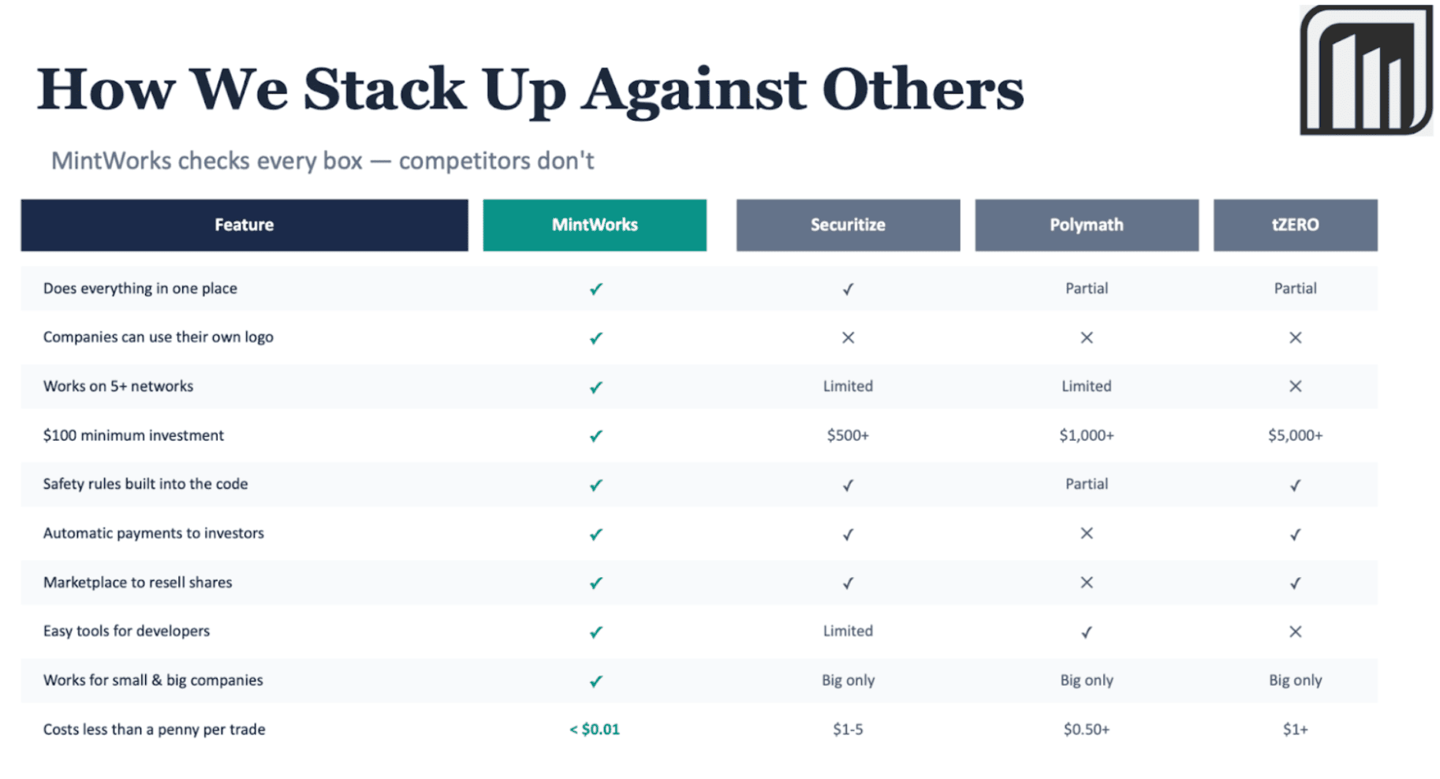
Miles ahead of single-focus businesses fragmenting the digital assets industry
The tokenization market is fragmented into three:
Companies like Polymath, Securitize, and tZERO that build software for other businesses
Giant financial firms building their own digital investment products, such as BlackRok, Franklin Templeton, and WisdomTree
Crypto token creators (Ondo Finance, Maple, Backed) creating tradeable tokens
MintWorks is the only holistic solution that offers everything in one place:
Traction
Platform + management system is already built
MintWorks has already developed two distinct software products:
The core tokenization platform, valued at up to $28 million
Treasury OS, an AI-powered treasury management system, valued at up to $12 million
The combined IP value stands at up to $40 million.
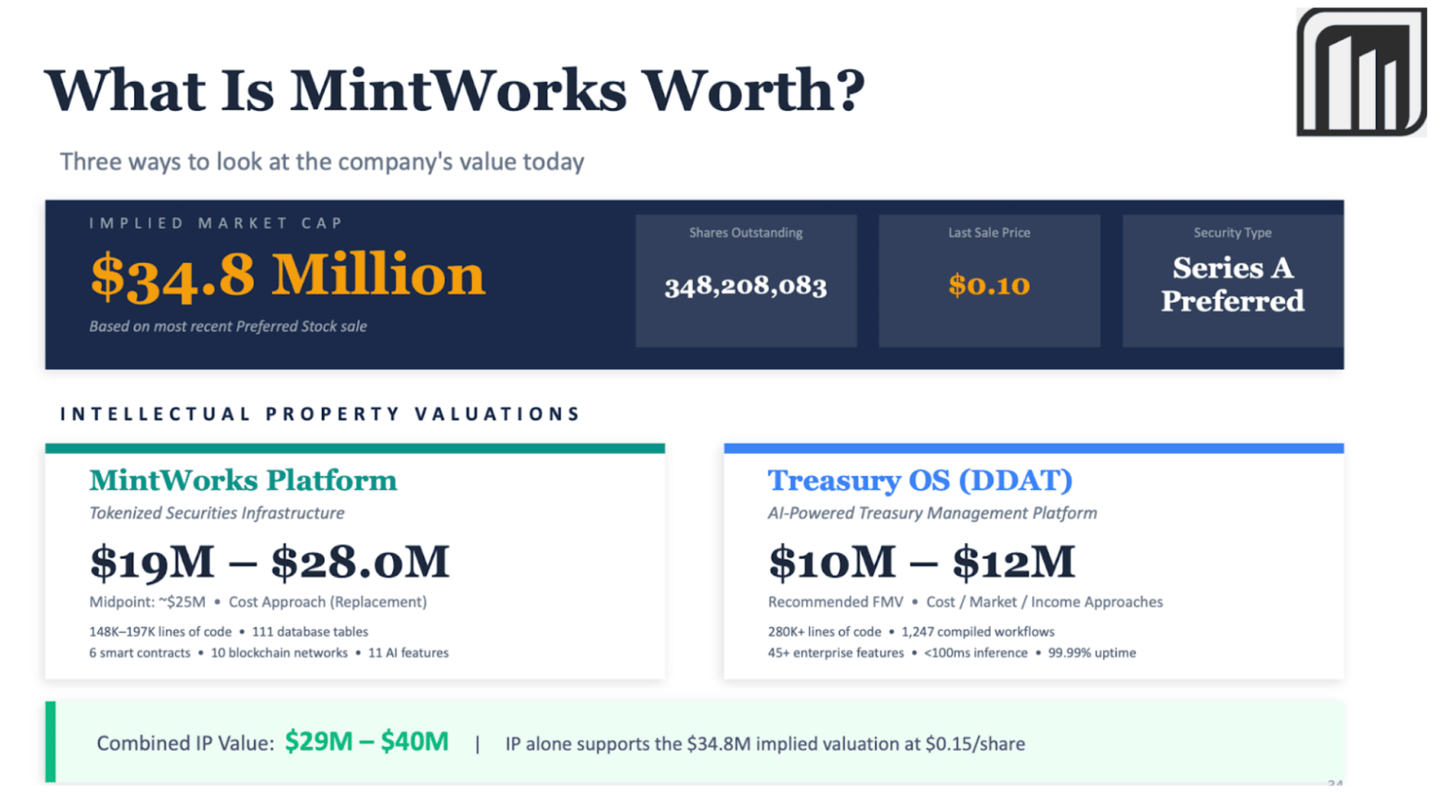
Near-term targets include up to 10 pilot clients and 5,000 investors onboarded in 2026, with a phased go-to-market strategy covering direct sales, white-label partnerships, and eventually a broker-dealer license and alternative trading system.
Vision and strategy
Rebuilding capital markets on rails designed for the next century of finance.
MintWorks Holdings, Inc. is building fully compliant end-to-end infrastructure for tokenization and lifecycle management of real-world assets — a unified operating system that vertically integrates capital formation and asset management. The platform replaces transfer agents, fund administrators, and compliance officers with a single programmable stack. Tokenization is the foundation, but the addressable market extends well beyond capital raising.
The existing financial system was built in the paper era and retrofitted for electronic trading. It depends on dozens of intermediaries — transfer agents, fund administrators, custodians, compliance officers, broker-dealers, clearing firms — each one a manual, human-operated checkpoint that adds cost, latency, and error. Tokenization is not about "putting stocks on a blockchain." It is about rebuilding the entire lifecycle of a security — issuance, compliance, distribution, settlement, servicing, secondary trading — on programmable rails that execute compliance at the protocol level, 24/7/365, with zero bypass paths.
MintWorks is the only vertically integrated platform that handles issuance, compliance (seven-check gating across KYC, AML, sanctions, PEP, accreditation, token whitelist, and jurisdiction), capital raising, fixed-income servicing, and a compliance-gated secondary market in a single system. Every other player covers one or two layers. We cover all of them.
Our Three-Phase Strategy
• Phase 1 — Land (Q1–Q2 2026): Direct sales to investment firms. Five to ten pilot clients in real estate and venture capital. Free developer tier. Thought-leadership content and industry conference presence.
• Phase 2 — Expand (Q3–Q4 2026): Law firm and advisor partnerships. White-label program for regional banks. Startup equity tokenization vertical. Integration with major custody providers.
• Phase 3 — Scale (2027 and beyond): Developer ecosystem and marketplace. Geographic expansion into EU and APAC. Enterprise API partnerships. Build toward IPO readiness.
Why This Works
Three independent forces are converging: regulatory clarity (SEC engagement, EU MiCA, ERC-3643 adopted as Ethereum's security-token standard), institutional demand (BlackRock's BUIDL fund, JPMorgan Onyx, Goldman GS DAP), and a 40–65% cost reduction versus traditional securitization. The tokenization market is projected to reach $11–19 trillion by 2030. We enter at the inflection point with the only production-grade, vertically integrated stack in market.
Impact
Opening private markets to everyone. Cutting issuance costs by 40–65%. Giving ownership its native digital form.
For Issuers — Access to Capital Without the Middleman Tax
A traditional private placement can cost $500,000 to $2,000,000 in legal, transfer-agent, fund-administration, and broker-dealer fees before a single dollar is raised. MintWorks collapses that stack into a software license. Issuers keep more of what they raise, close faster, and reach global investors through a compliant, white-labeled portal. Enterprise deal range validated at $490,000 to $740,000 in Year 1 per issuer — a fraction of the cost of the legacy approach.
For Investors — Liquidity, Fractional Access, and Self-Custody
Private securities have historically been illiquid, opaque, and restricted to the wealthy. Tokenized securities on MintWorks can be held in self-custody wallets, transferred peer-to-peer between eligible investors, pledged as collateral, and traded on a compliance-gated secondary market. Minimum investment sizes drop. Settlement moves from T+2 to near-instant. Ownership becomes transparent and verifiable on-chain.
For the Capital Markets System
• Programmable compliance. Seven-check gating — KYC, AML, sanctions, PEP, accreditation, token whitelist, jurisdiction — enforced at every transfer, deposit, swap, and settlement, with zero bypass paths and a 48-hour timelock on any disable action.
• 24/7/365 markets. Traditional securities trade roughly 1,680 hours per year. Tokenized securities on MintWorks trade 8,760 hours per year.
• Instant, atomic settlement. T+0 delivery-versus-payment replaces the two-day settlement cycle that still creates systemic risk in traditional markets.
• Auditable by design. Every transaction is cryptographically signed, timestamped, and permanently recorded — a regulator's dream compared to the paper trails of legacy finance.
By the Numbers
|
Metric |
Value |
|
Target market (tokenized RWAs by 2030) |
$11–19 trillion |
|
Issuance cost reduction vs. traditional securitization |
40–65% |
|
Compliance checks enforced at every transfer |
7 |
|
Bypass paths in the compliance layer |
0 |
|
Hours of market availability per year |
8,760 (vs. 1,680 in TradFi) |
Funding
Most investors in a company like this never get to know where every dollar came from, or where every dollar is going. You do. Here it is — in plain English.
What we've raised so far
MintWorks Holdings, Inc. was incorporated in Delaware on September 18, 2025 (originally as DDAT Holdings Inc., renamed to MintWorks Holdings Inc. on February 18, 2026). From founding through the date of this campaign, we have raised a combined total of approximately $575,000 in cash and brought in $500,000 of intellectual property through non-cash equity contributions.
Here is every prior financing transaction — no hidden rounds, no sidecar vehicles:
Date | What was issued | Amount | How it was used | Exemption |
Sept 2025 | Founder Equity (Class A Common) | $75,000 | Organization services (non-cash) | 4(a)(2) |
Oct 2025 | IP Contribution (Class A Common) | $500,000 | IP assigned by CEO (non-cash) | 4(a)(2) |
Oct 2025 | Seed Common Stock | $350,000 | Working capital, digital asset treasury | Reg D 506(c) |
Dec 2025 | Series A Preferred | $25,000 | Working capital | Reg D 506(c) |
Jan 2026 | Series A Preferred | $25,000 | Working capital | Reg D 506(c) |
Jan 2026 | Series A Preferred | $150,000 | Working capital | Reg D 506(c) |
Mar 2026 | Series A Preferred | $25,000 | Working capital | Reg D 506(c) |
Total cash raised | — across 5 Reg D 506(c) closings — | $575,000 |
What this means in practice
The team built the platform first. Of the $575,000 in outside cash raised to date, roughly $335,000 is still on our balance sheet as of March 31, 2026 — $137,449 in cash across three Chase accounts and $325,945 in digital asset reserves (primarily Bitcoin, Solana, Monad, and USDC). The rest has been invested in the platform, the legal infrastructure, the engineering audits, and the team salaries that got us to the commercial launch point.
The CEO contributed the core IP, not cash. On October 8, 2025, our CEO Saeed Talari assigned the MintWorks, TreasuryOS, and FintechOS software platforms to the Company in exchange for 250,000,000 shares of Class A Common Stock, at a Board-determined value of $500,000 ($0.002 per share). An independent third-party valuation, commissioned separately, valued the combined IP at $29–40 million using standard replacement-cost methodology. This is disclosed in full in the Form C — we are not hiding the related-party transaction, and the SAFE instrument you would be purchasing is junior to no one on the cap table except standard creditor claims.
What we're raising now
This Republic campaign is one of two parallel offerings we're running right now. We want you to understand both, so nothing is hidden.
Offering 1 — This Republic campaign (Regulation Crowdfunding)
Security | Series 2026 SAFE (Simple Agreement for Future Equity) |
Minimum investment | $100 |
Maximum investment per investor | $124,000 (subject to Reg CF annual limits based on your income & net worth) |
Target raise (must hit to close) | $50,000 |
Maximum raise | $1,200,000 |
Valuation cap (pre-money) | $50,000,000 |
Discount | 20% off the next priced round |
Conversion trigger | Our next priced equity round of $6,000,000 or more — at that point, your SAFE converts into shares |
Offering deadline | 90 days after Form C qualification |
Where your money is held | Escrow until the $50,000 target is met; custody by Brassica Trust Company LLC thereafter |
Your right to cancel | Up to 48 hours before the offering deadline — full refund, no questions asked |
Offering 2 — Parallel Reg D 506(c) round (accredited investors only)
At the same time, we are also raising up to $5,000,000 in Series A Preferred Stock from accredited investors only, under Rule 506(c) of Regulation D. That offering is legally separate from this one — it is not on Republic, and only investors who meet the SEC's accredited-investor income and net-worth requirements can participate.
Why you need to know this: If that parallel round is successful, accredited investors will receive Preferred Stock with a liquidation preference that is senior to your SAFE. That's not unusual — it's how most startup cap tables work — but we want you to see it, not discover it in a footnote. The Form C spells this out in the Risk Factors section, and we recommend you read it before investing.
What the money will do
This is the exact use-of-proceeds table from our Form C. We show it two ways — what happens if we hit only the $50,000 target, and what happens if we hit the full $1,200,000 maximum — because the allocation changes materially at scale.
Category | % at $50K | $ at $50K | % at $1.2M | $ at $1.2M |
Intermediary (Republic) fees | 24% | $12,000 | 7% | $84,000 |
Engineering & Product | 20% | $10,000 | 33% | $396,000 |
Sales & Marketing | 10% | $5,000 | 19% | $228,000 |
Digital Asset Treasury (BTC/ETH) | 0% | $0 | 14% | $168,000 |
Compliance & Legal | 20% | $10,000 | 12% | $144,000 |
Working Capital & Operations | 26% | $13,000 | 15% | $180,000 |
Total | 100% | $50,000 | 100% | $1,200,000 |
In plain words, what each bucket actually means
Engineering & Product — $10K to $396K. Hiring engineers, running independent security audits on our smart contracts, integrating additional blockchain networks, and scaling our infrastructure so we can support enterprise clients without it breaking. The platform is working today; this is what it takes to make it work at scale.
Sales & Marketing — $5K to $228K. Sales salaries, conference attendance, content marketing, digital advertising. A working platform without a sales team is just expensive software. This is what turns the product into revenue.
Digital Asset Treasury — $0 to $168K (max raise only). If we hit the maximum $1.2M, we allocate 14% to BTC and ETH reserves, held through regulated institutional custodians (Coinbase Prime). ETH staking generates 4–5% annual yield. This is a balance-sheet strategy, not speculation — and you should know that digital asset prices are volatile, which we disclose as a risk factor.
Compliance & Legal — $10K to $144K. SEC filings, state-level securities filings, ongoing legal counsel, transfer-agent registration, KYC/AML infrastructure, and external accounting reviews. Being in the securities business means constant legal work.
Working Capital & Operations — $13K to $180K. CEO and CMO salaries ($10K/month each per their employment agreements), software subscriptions (Replit, cloud hosting, AI tools), bookkeeping, office and administrative costs, and a contingency reserve.
Intermediary Fees — $12K minimum to $84K. Republic gets the greater of 7% of what's raised or $12,000. They also receive 2% of the total securities issued. This is standard for Reg CF crowdfunding and is disclosed on every deal.
Why the $50M valuation cap
This is the question every smart retail investor asks — and it's the right question. A $50M valuation cap on a SAFE means that if we later raise a big, priced round at, say, $200M, your shares are priced as if you paid in at $50M. That's meaningful upside — but only if the $50M is a reasonable starting point in the first place. Here's why we think it is.
Reason 1 — The IP alone was independently valued higher
We commissioned an independent valuation of the software platforms the CEO contributed to the Company. Using the industry-standard COCOMO II replacement-cost methodology (the same model large enterprises use to value internally developed software), the analysis found:
Asset | Independent valuation range |
MintWorks tokenization platform | $19,000,000 – $28,000,000 |
TreasuryOS digital asset management platform | $10,000,000 – $12,000,000 |
Combined IP value | $29,000,000 – $40,000,000 |
So the software alone — before we count the team, the regulatory work, the customer pipeline, or the market position — supports a valuation in the range of $29M to $40M. The $50M cap is a reasonable premium above that to account for the operating business, regulatory progress, and market timing.
Reason 2 — It's priced in line with our most recent priced round
In March 2026, we sold Series A Preferred Stock to accredited investors at $0.10 per share. Based on 348,208,083 total shares outstanding at that price, the implied market capitalization of MintWorks is approximately $34,800,000. The $50M SAFE cap reflects a premium on top of that most-recent priced round to account for the platform progress and digital asset treasury growth since March — and to leave meaningful upside for you, the SAFE investor, if we execute well.
Reason 3 — The CEO has done this before
Saeed (Sam) Talari, our CEO and Founder, has taken three companies from $0 to IPO in his career. That's over $430M in combined IPO market capitalization created, plus 25+ years of SEC and FINRA experience, plus 10,000x ROI on prior crypto and blockchain investments. Most pre-seed founders can't credibly claim they know how to get a company public. This one has done it three times.
Things about this round you should also know
Why we're being explicit about these Under the securities laws, material information must be disclosed. These items are all in the Form C — but retail investors don't always read 80-page SEC filings. So, we're putting the most important flags right here, on the campaign page, where you'll actually see them. |
1. Going-concern qualification. Our independent accountants' review of our 2025 financials includes a "going concern" qualification, which means they formally noted substantial doubt about our ability to continue operations without additional capital. This is normal for a development-stage startup with no revenue, but you should know it's in the record.
2. CEO voting control. We have a dual-class stock structure. Our CEO holds Class B Common Stock with 10 votes per share, giving him approximately 96% of the total voting power. SAFE holders have no voting rights before conversion, and upon conversion your votes will be exercised by a designated Lead voting consistently with the CEO's direction. If you invest, you're trusting the CEO's judgment on corporate decisions.
3. Related-party IP transfer. The core IP was contributed by the CEO to the Company at a $500,000 Board-determined value, without an independent third-party appraisal at the time of contribution. The independent $29–40M valuation was commissioned after the fact. The SEC does not require pre-contribution appraisal, but the related-party nature of the transaction is a disclosed item.
4. No revenue yet. MintWorks has not yet generated revenue. We are a development-stage company. Our financial projections depend on successful commercial launch and customer acquisition, neither of which is guaranteed.
5. Digital asset treasury volatility. Approximately 32% of our assets are digital assets (BTC, SOL, MON, USDC). We recognized approximately $29,000 in unrealized losses on these through December 31, 2025, and approximately $66,000 in cumulative unrealized losses through March 31, 2026. Crypto prices can decline sharply in short periods.
One final thing
Most pre-seed companies offer retail investors glossy decks and a low minimum and call it a day. We are giving you the same level of detail a Series A venture capital fund would demand in due diligence — because it's your money, and because the securities laws require honesty, and because we think you can handle it.
If you're still interested after reading this section, please read the full Form C on this campaign page and the SAFE agreement before investing. If anything in this section doesn't match the Form C, the Form C governs — and please flag it to us, because that would be our mistake to correct.
Invest only what you can afford to lose. Read everything. Then decide. |
Founders
A team that has built, scaled, and taken public companies before — now building the infrastructure layer for the next trillion dollars of assets.
Sam Talari III — Chief Executive Officer & Chief Technology Officer
35+ years in enterprise software. Three IPOs. Over $630 million in combined market capitalization across prior ventures. Sam has led engineering and product organizations through full lifecycles from seed to public listing, with deep expertise in financial infrastructure, distributed systems, and regulated technology. At MintWorks, he is the architect of the vertically integrated platform and the chief technologist responsible for the 26-smart-contract, zero-vulnerability codebase.
Sam's focus on MintWorks: platform architecture, smart-contract security, engineering culture, and the technical roadmap for ZK compliance, multi-chain deployment, and fixed-income servicing.
Dr. Olga Krynina — Chief Marketing Officer
PhD in Marketing Science. Olga brings academic rigor and applied go-to-market experience to one of the most complex demand-generation challenges in fintech: selling a category-defining infrastructure product to issuers, institutions, and developers simultaneously. Her work at MintWorks combines quantitative market research, narrative strategy, and enterprise sales enablement.
Olga's focus on MintWorks: investor narrative, brand positioning, content strategy, and the full-funnel go-to-market engine that will scale from 5 pilot clients to 50+ paying issuers.
Key Hires on the Roadmap
- Chief Financial Officer — Post-Series A. Public-company CFO track preferred, given IPO trajectory.
- Chief Compliance Officer — Post-Series A. Securities law background, broker-dealer or transfer-agent experience.
- VP of Sales — Enterprise fintech sales leader to own the path from 5 to 50 paying issuers.
Summary
Right now, the best investments in the world are off-limits to you.
Think about it. The richest people you know — they don't just own stocks. They own pieces of apartment buildings. They own shares of private companies before those companies go public. They own farmland, warehouses, venture capital funds, private credit.
You can't touch any of that.
Your 401(k) holds public stocks and bonds. Maybe an index fund. That's it. If you want to buy into an office building in Miami, you need at least $250,000 and a phone call to a broker who won't return it. If you want to back a startup before it IPOs, you need to already be rich — the accredited investor rule requires $200,000 in income or $1 million in the bank.
The system was built this way on purpose. Private investments — the kind that have historically beaten the stock market — have always been walled off for the wealthy. Everyone else gets the leftovers.
That wall is about to fall. MintWorks is the company building what replaces it.
What this means for your life
Imagine the world five years from now.
You want to invest in real estate.
Instead of scraping together $50,000 for a down payment on a rental property, you open an app and buy $200 worth of shares in a downtown office building in Austin. You own a real, legal piece of it. Every month, the rent hits your account automatically. If you want to sell, you tap a button.
You want to back the next Uber before it goes public.
Today, that's impossible unless you're already wealthy. In the new system, the startup offers a portion of its shares to regular people. You buy $500. If the company IPOs at 20x what you paid, that's $10,000 — the kind of upside that was reserved for Silicon Valley insiders for forty years.
You want your savings to earn real income.
Private credit — lending money to mid-sized companies at 8–12% — has been a favorite of pension funds and billionaires for decades. In the new system, you can put $1,000 into a private credit fund and earn the same rates they do. No middleman taking 2% off the top.
You want to actually hold what you own.
Right now, your broker holds your stocks. You get a statement. In the new system, your ownership is yours — held in your own digital wallet if you want, with your name on it, transferable the way you transfer money on Venmo. If your broker goes bankrupt, your assets aren't stuck in their pile.
This isn't science fiction. The biggest asset managers in the world — BlackRock, JPMorgan, Franklin Templeton — have already moved billions of dollars onto this new system in the last 18 months. |
Why now? Because the rails are being laid today
Every major shift in finance comes from the same pattern: new rails get built, then the whole market migrates onto them.
When NASDAQ launched in 1971, it digitized stock trading. Before that, every trade involved paper, runners, and trading floors. The people who built NASDAQ became the backbone of modern markets.
When Charles Schwab made online trading cheap in the 1990s, it brought millions of regular people into the stock market for the first time. The company that built those rails became a household name.
What's happening now is bigger than either of those.
The rails for private investments are being built right now.
Real estate, private companies, investment funds, private credit — the entire trillion-dollar world of private markets — is being rebuilt on modern software. When it's done, you'll be able to own pieces of almost any asset from your phone, with the same ease as buying a stock on Robinhood.
This market is projected to grow from $25 billion today to over $11 trillion by 2030. That's not a typo. That's a 440x expansion in six years.
MintWorks is building the underlying infrastructure. The software. The plumbing. When an office building gets tokenized, when a startup offers shares to regular people, when a private credit fund opens up to small investors — a platform like ours handles the legal work, the compliance, the payments, the marketplace.
We are not selling you a piece of any one building or fund. We are selling you a piece of the company that makes all of it possible.
The big idea, in one sentence
Shopify doesn't sell t-shirts — it sells the software that lets a million small businesses sell t-shirts. MintWorks doesn't sell buildings or stocks — we sell the software that lets anyone issue, sell, and trade ownership in anything. |
When this shift happens — and it is happening — the platforms that power it will be among the most valuable companies of the decade. The same way Shopify's stock went up more than 50 times over in the e-commerce wave, the companies that power the tokenization wave stand to capture enormous value.
You are not investing in a building. You are not investing in a startup. You are investing in the machine that will process the next trillion dollars of both.
What you actually get if you invest
You're buying | A piece of MintWorks — the company building this infrastructure. Legally: a SAFE, which converts into real shares when we raise our next big round. |
Your price advantage | You get a 20% discount off whatever future investors pay, capped at a $50 million company valuation. Whichever gives you more shares is what you get. |
Your cash flow | None yet. Startups reinvest. You make money if the company grows and either gets acquired, goes public, or raises a big round at a higher price — that's when your SAFE turns into shares worth more than you paid. |
If things go badly | Startups can fail. You could lose everything you invest. That's the honest truth. Invest only what you can afford to lose. |
If things go well | A successful infrastructure company in a trillion-dollar emerging market can be worth 50x to 500x its seed valuation. We're not promising that. We're saying: that's the shape of the opportunity. |
The honest truth about risk
We're not going to sugarcoat this. Startups are risky. Most of them fail. If you invest $500 in MintWorks, here are the realistic possibilities:
- You lose it all. The most common outcome for any single startup investment. The company runs out of money, pivots badly, or gets outcompeted. Your SAFE becomes worth nothing.
- You roughly break even. MintWorks survives but doesn't become a category leader. Gets acquired for a modest amount. You get your money back, maybe a little more.
- You make a small multiple. MintWorks grows into a solid business, raises a bigger round at $200M or $500M, or gets acquired. Your $500 becomes $2,000 to $5,000.
- You hit the long-shot. MintWorks becomes the Shopify of tokenization. Goes public. Your $500 becomes $25,000 or more. This is rare. But it's what early investors chase.
We believe the probability is skewed toward the better outcomes because the platform is already built, audited, and running. Most startups at this stage are still figuring out if their idea works. We know ours does — we just need to grow the customer base. But belief is not certainty.
Only invest money you can afford to lose entirely. This should never be your rent money, your emergency fund, or money earmarked for something important.
Why this round, why now
Most people never get the chance to invest in a company like this at this stage. Not because they couldn't afford it — a Republic investment is smaller than a new phone. But because deals like this have historically been restricted to venture capitalists and wealthy insiders.
Regulation Crowdfunding changed that. You can now invest in private companies the same way Silicon Valley does — at the beginning, before the valuation has multiplied, before the category is obvious.
The tokenization wave is early. The infrastructure is being built. The rules are getting clearer. The biggest money in the world is moving in. You can either watch the next transformation of finance from the sidelines or own a piece of the company building it.
The minimum is small. The risk is real. The upside is asymmetric. Read the offering materials. Decide for yourself.
Before you invest Read the full Form C and all risk factors on this campaign page. Understand that you could lose your entire investment. MintWorks is not your financial or legal advisor — if you're unsure, talk to someone who is. Only invest what you can afford to lose. |