Is prepaid vacation the next frontier in insurance products?
·
Jun 9, 2026
A California startup thinks so, and it is raising $5 million on Republic to prove it


 Oops! We couldn’t find any results...


 Form C
SEC.gov
Form C
SEC.gov
Americans spend $170B on life insurance—yet almost no one has a structured monthly plan for happiness while they're alive.
Valuable family experiences and memories are pushed to “someday”—which often never comes.
👉 People insure against unlikely calamities.
👉 But they don't plan for assured happiness.
 Life insurance pays after you're gone. Happiness Insurance® delivers while you're alive.
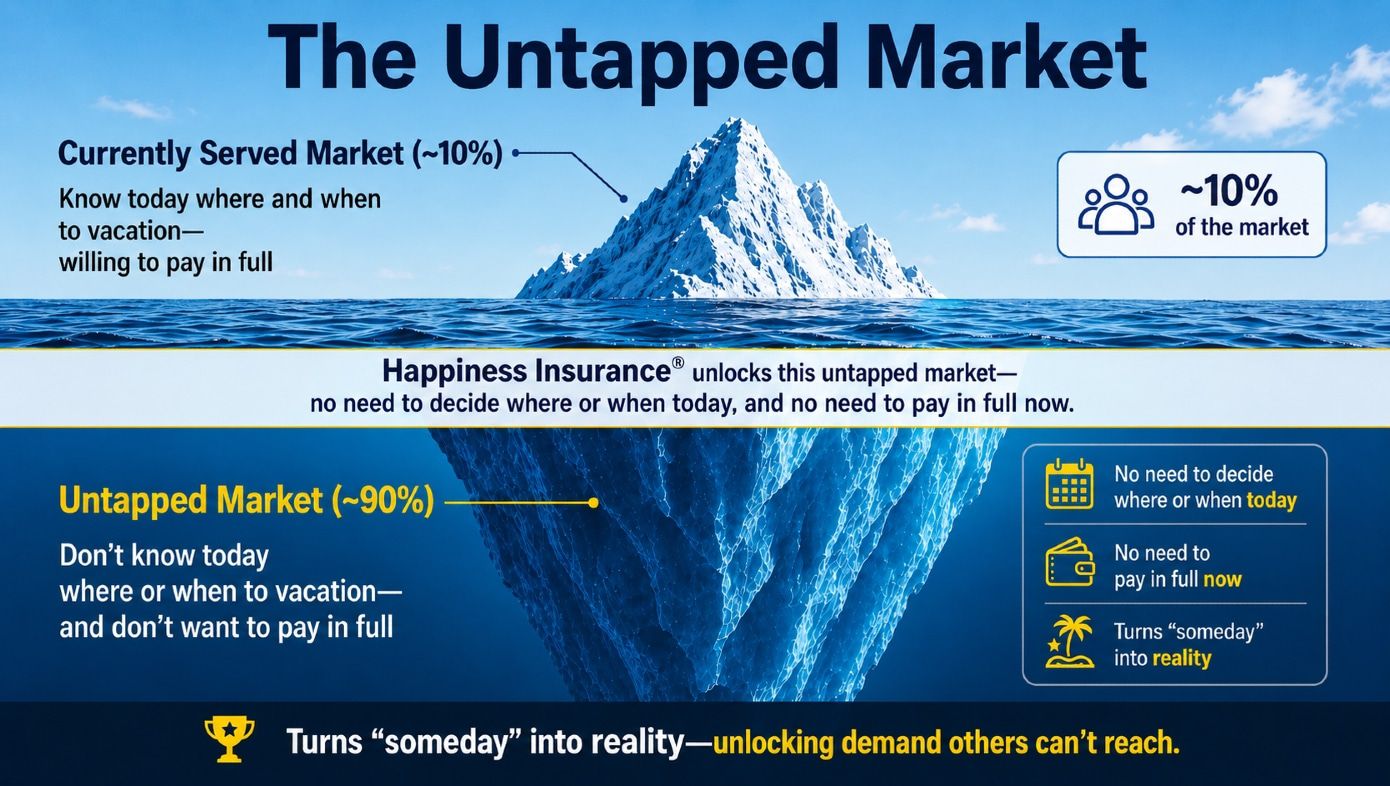
Happiness Insurance® is a structured plan for happiness—helping families overcome the barriers of money, time, and planning, even if they don't know today where or when to vacation.
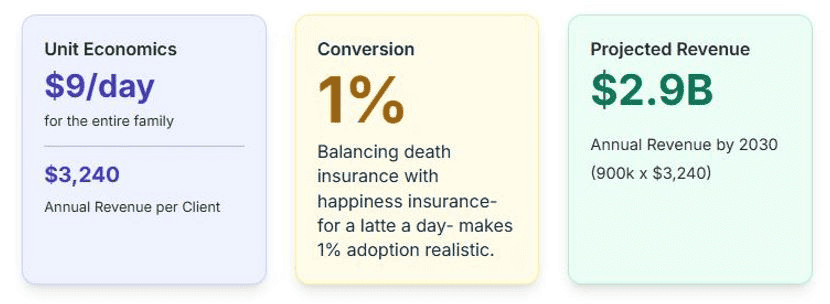
For $9/day, paid monthly, families of 4 can vacation anytime in the next 12 months while a concierge handles the planning—at 2,000+ resort destinations, including Marriott, Hilton, and Disney area properties.
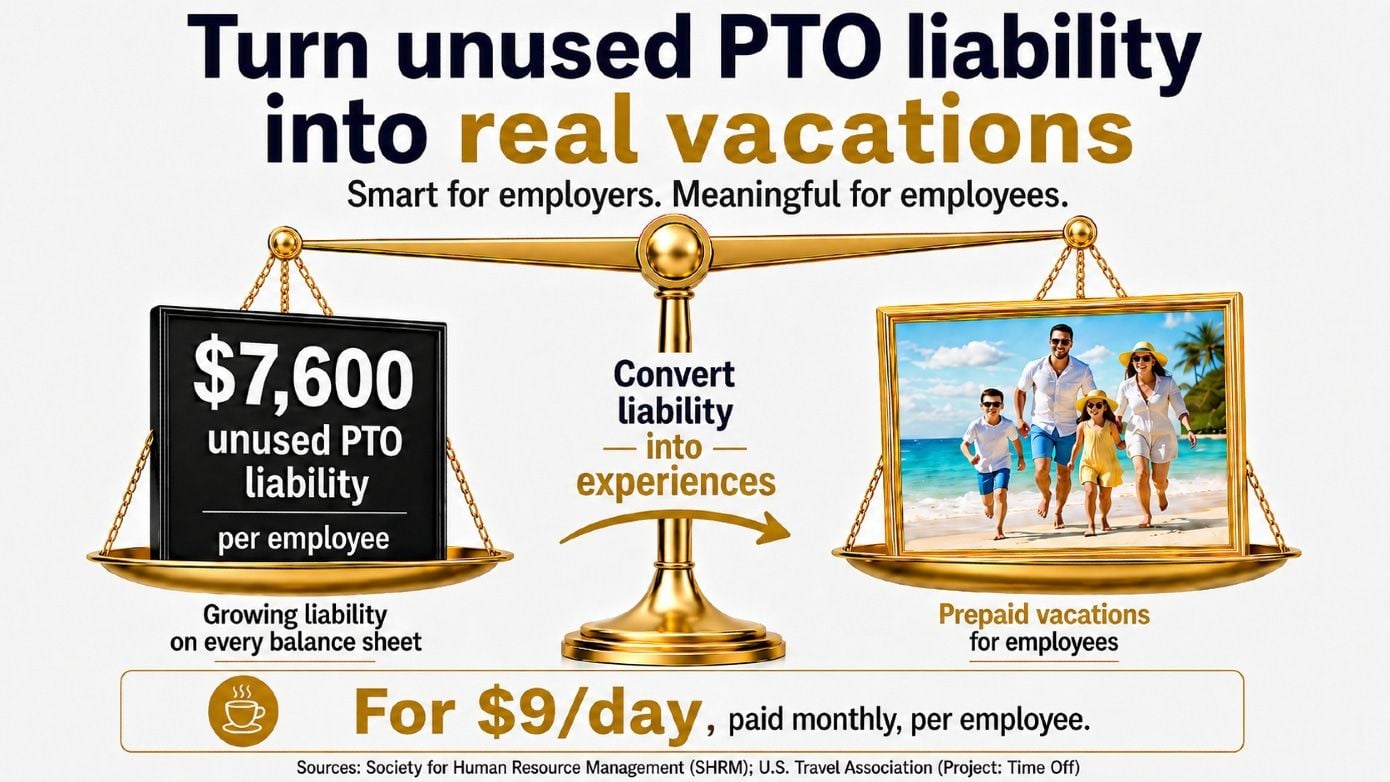
For businesses, we help convert unused PTO liability on balance sheets into measurable ROI—driving engagement and retention by incentivizing employees with prepaid family vacations to actually take their time off.
Proven Demand & Strong Unit Economics

Pilot results prove strong demand for Happiness Insurance®
$169,000 in revenue from just 60 customers, with approximately $2,800 average revenue per customer, confirms strong demand and willingness to pay.
This traction — reinforced by 14 public YouTube customer testimonials — validates a new category: structured plans for happiness.
Published on MarketWatch, Reuters, Yahoo Finance, and syndicated across 141 radio stations, we are driving brand credibility and inbound interest.
Backed by USPTO-registered IP and 30+ years of industry leadership, we are positioned to scale this traction across consumer and employer channels—unlocking a much larger, untapped market.
Uncompensated testimonials from professionals who vetted our happiness plan. No actors. No scripts. Real value.
“My employees were super happy!”— Charles G. President, Renewal by Andersen

B2C: Enabling 90M Americans who already pay monthly for death benefits (ACLI) to create family experiences & memories through a structured plan for happiness—for $9/day.
B2B: Converting $312B in unused PTO liability annually into retention & productivity by incentivizing employees to actually take their time off—through prepaid family vacations.
Partnerships & IP Licensing: Unlock scale through potential partnerships with U.S. insurers—designed to improve policyholder well-being, reduce claims, and increase premium lifetime value—while monetizing USPTO-protected IP globally.
Just 1 in 100 of 90M life insurance customers choosing to balance death benefits with happiness benefits = $2.9B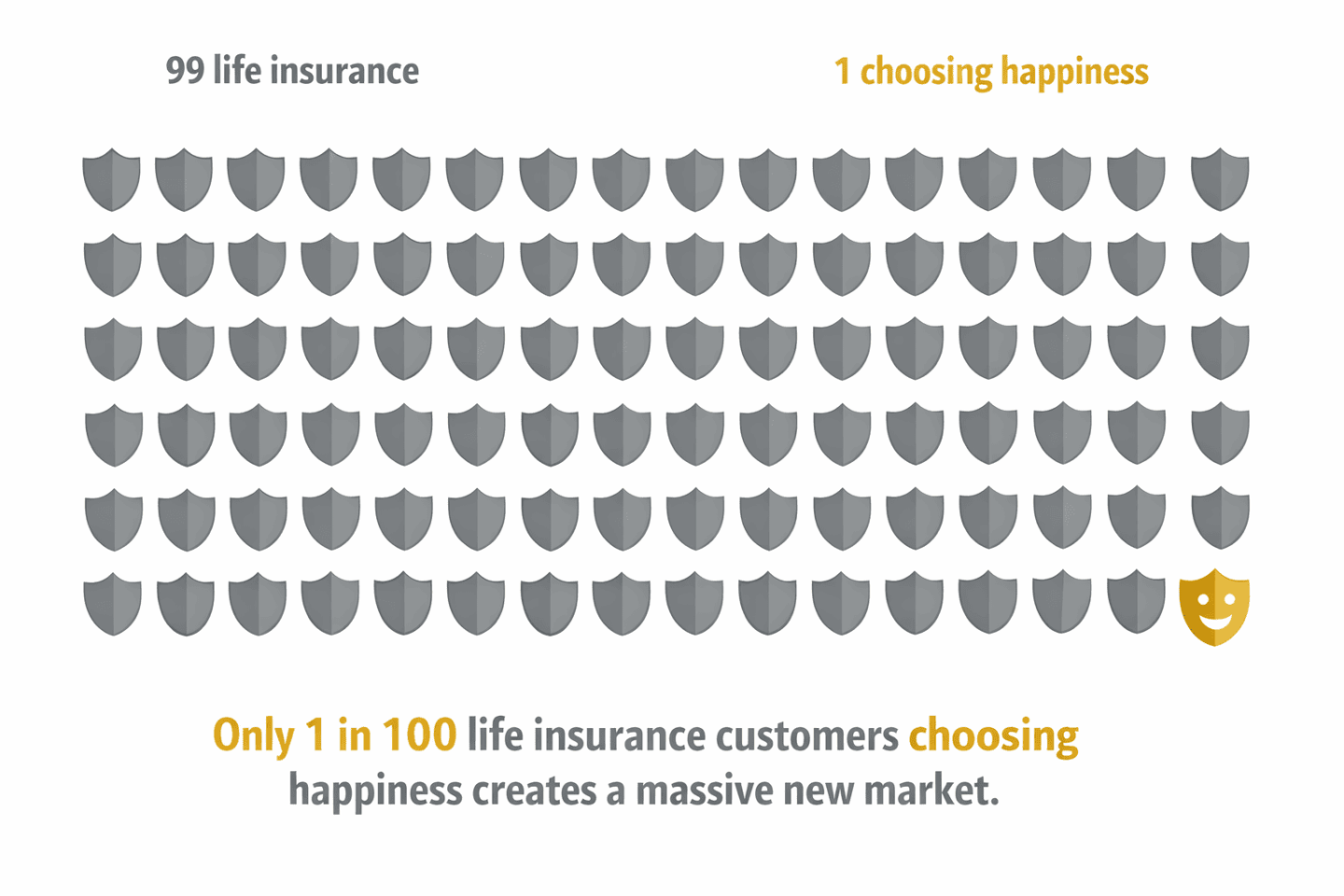

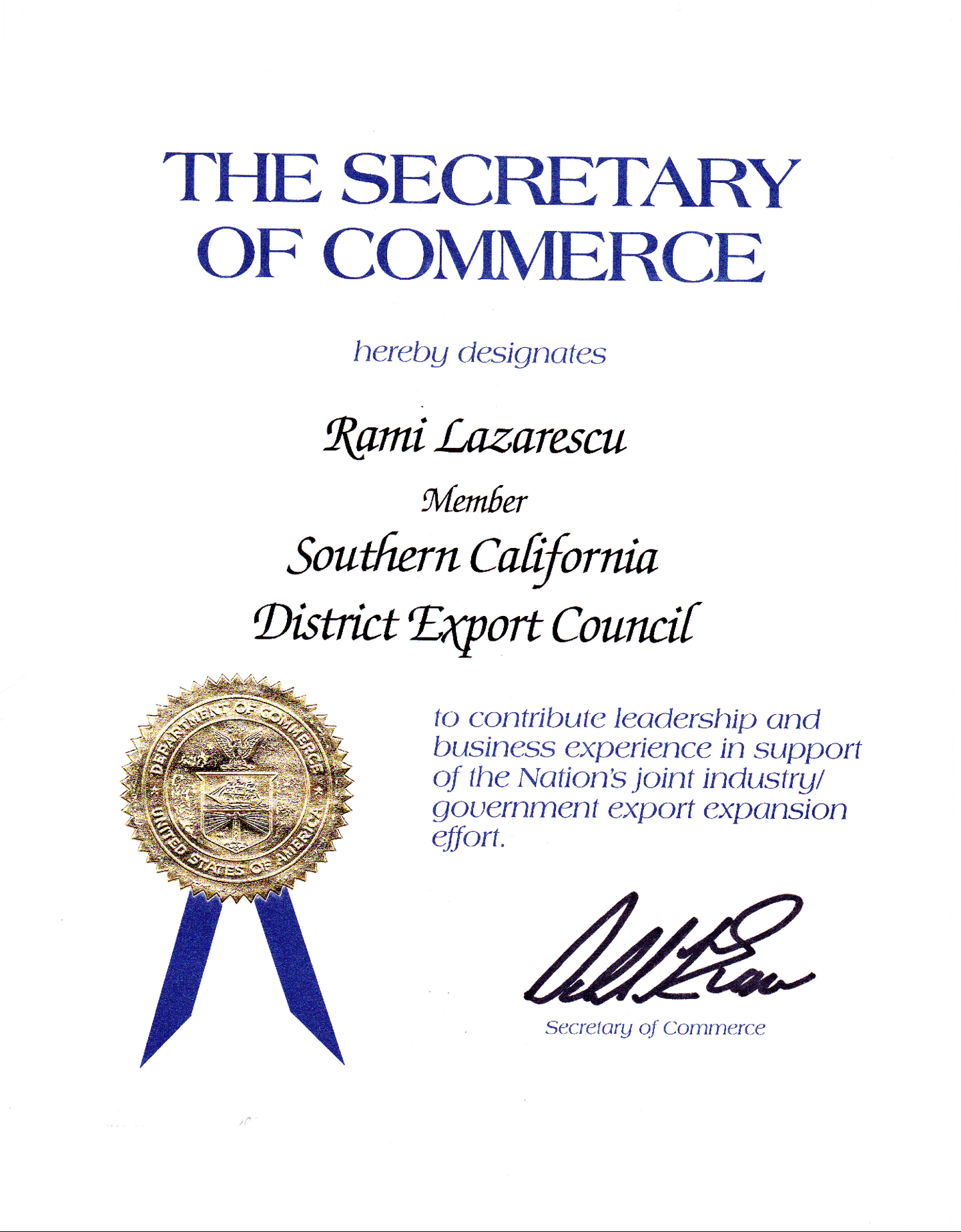
Founder and CEO Rami Lazarescu is a 30-year veteran of the vacation industry and founder of Ampro Vacations. He received the President’s “E” Award for outstanding contributions to U.S. exports and was appointed by the U.S. Secretary of Commerce to the Export Council, advising on national export expansion.
His decades of industry relationships, supplier partnerships, and operational experience helped lay the foundation for Happiness Insurance®’s scalable global business model.

Strategic Advisor Paul Lazarescu brings AI, technology, and scaling expertise, including 10 years at Google, where he serves Group Product Manager for AI on Discover, a degree from MIT, experience at McKinsey, and teaching Product Management at Boston University.
Traditional Providers (Expedia, Airbnb, Hotels & Resorts)
Require customers to know today exactly where and when to vacation—and to pay in full upfront.
Vacation Clubs & Timeshares
Typically require high upfront costs, increasing annual fees without a cap, and long-term contractual commitments that are difficult to cancel or exit.
Happiness Insurance®: An affordable structured plan for happiness that lets customers invest in happiness now and decide where and when to vacation later—without needing to pay in full today.
Our vision is to make Happiness Insurance® a new standard in how people invest in life—helping millions allocate a small portion of their spending—$9/day—toward meaningful experiences and lasting happiness.
As people increasingly prioritize experiences over possessions, we are defining a new category—removing money, time, and planning barriers to make vacations more accessible at scale.
Through consumer plans, corporate programs helping convert $312B in unused PTO (SHRM) into engagement and retention, and global licensing, we are scaling through three core revenue streams.
We also see potential partnerships with U.S. and global insurers seeking to improve well-being, reduce claims, and enhance long-term customer value.
Happiness Insurance® is designed to make meaningful experiences and family memories accessible at scale.
Research from Cornell University shows that vacations create more lasting happiness than money or material possessions—yet millions of people still miss out due to money, time, and planning barriers.
By removing these obstacles, our structured plan for happiness helps families turn “someday” into reality—while helping employers reduce burnout, increase engagement, and convert unused PTO liability into measurable ROI.
Our goal is to help people and businesses—for just $9/day—invest in experiences that reduce stress, increase happiness, and improve work-life balance.
We’re raising capital to accelerate growth in a new category: Happiness Insurance®.
Minimum: $50,000 | Target: $3,200,000
Use of Proceeds:
46% Marketing & Customer Acquisition • 20% Technology • 15% Operations • 15% Working Capital • 4% Fees
Capital will be primarily deployed into customer acquisition—scaling a proven model that generated ~$2,800 per customer in our pilot—supported by technology and operations designed to efficiently scale customer acquisition and fulfillment.
Our strategy is to scale a proven, repeatable business model—converting demand into recurring revenue while expanding consumer (B2C), employer (B2B), and insurance partnership channels.

Rami’s parents never took him on a vacation. Not once. They’re both gone now, and he has no vacation memories of them together.
That loss — and 30+ years building and operating Ampro Vacations while watching families postpone vacations to “someday” that often never comes — led him to create Happiness Insurance®: a category-defining company pioneering affordable, accessible, living benefits.
His insight: people invest more in protecting against unlikely calamities they don’t want than in assured, memorable experiences they do want.
CEO Rami Lazarescu received the President’s “E” Award and was appointed by the Secretary of Commerce to serve on the Export Council. Featured in MarketWatch, Reuters, and Yahoo Finance, and interviewed on 141 radio stations.
Happiness Insurance® is creating a new category—a structured plan for happiness built around vacations that drive well-being, engagement, and performance—for $9/day.
90M Americans spend $170B annually on life insurance (ACLI)—protecting against the financial impact of death—yet spend little on structured plans for happiness while alive.
For consumers, we remove money, time, and planning barriers—turning “someday,” which often never comes, into reality.
For businesses, we convert unused PTO liability on balance sheets into prepaid vacations employees actually take—driving sales, engagement, and retention.
With USPTO-registered IP, proven demand, and national media recognition, we’ve laid the foundation for the world’s Happiness Insurance® category.
Form C
SEC.gov





Anguilla, Belarus, Belgium, Bermuda, Bonaire, Sint Eustatius and Saba, Cuba, El Salvador, France, Grenada, Guadeloupe, Haiti, India, Indonesia, Iran, Israel, Jamaica, Japan, Montserrat, North Korea, Qatar, Russia, Saint Kitts and Nevis, Syria, Turks and Caicos Islands, Venezuela, and Vermont, USA.
Companies will utilize a custodian to ensure that all securities they offer in their campaign are in one place. This means if a liquidity event or any other material event in respect to the securities occurs, the company can look to the custodian to service the securities, rather than each individual investor.
For investors, utilizing a custodian safeguards their investment, or security interest, with a qualified financial institution. Having a custodial account allows for easier transfers and creates additional layers of protection for your securities. For companies, it can increase efficiency by reducing their cap table management costs and creating a single-line item, making future funding rounds easier.
Right now, there are no costs for investors to open a custodial account.
Custodial accounts do sometimes have a low annual cost to maintain; however, such costs are covered for the investor in this offering at this time.
We are using Republic's SAFE security. Learn how this translates into a return on investment here.
All investments are processed through Republic’s regulated investment platform and held in escrow with BitGo (NYSE: BTGO), a leading institutional custodian.
Investor funds remain protected until the offering minimum and closing conditions are satisfied. Investors incur no additional escrow or custody fees.
BitGo also maintains investor ownership records and related transaction administration.
A structured plan that turns affordable monthly payments into meaningful family vacations. For $9/day, families of four can vacation anytime in the next 12 months at 2,000+ resort destinations worldwide—including Marriott, Hilton, and Disney-area properties—while our concierge handles the planning.
Unlike life insurance, which pays after you're gone, Happiness Insurance® delivers living benefits while you're still alive.
No. Happiness Insurance® is a trademarked prepaid vacation-benefits and incentive platform—not a licensed insurance product. It does not provide underwriting, indemnification, or risk transfer.
The name reflects a new category focused on helping people create meaningful experiences and memories while they are still alive.
The Company has three primary revenue streams:
• B2C structured happiness plans for prepaid vacation experiences
• B2B employee incentive programs tied to performance and PTO utilization
• Licensing and partnership opportunities leveraging the Happiness Insurance® brand and IP
The model combines recurring revenue with scalable brand expansion opportunities.
Because it removes the three biggest barriers that keep families from vacationing:
• Money — about $9/day paid monthly, with no large upfront commitment
• Time — vacation anytime within 12 months, with no need to decide today
• Planning — concierge handles everything.
Even families who do not yet know where or when they want to go can begin planning and funding future vacations today.
The model transforms “someday”—which often never comes—into a real plan and something families can look forward to.
Yes. A completed pilot generated approximately $169,000 from 60 paying customers at an average of ~$2,800 per customer—demonstrating strong willingness to pay and early market validation.
The Company has also received strong customer feedback, 14 public YouTube testimonials, and growing national media recognition.
Traditional travel platforms, resorts, and hotels sell vacations only after people have already decided where and when to vacation. Happiness Insurance® solves an earlier behavioral problem—helping people systematically plan and fund vacations over time by removing the barriers of money, time, and planning, even before they know where or when they want to vacation.
That demand is unmet by the traditional travel industry.
Helping just 1% of Americans already paying monthly for death benefits rebalance toward happiness creates a clear path to a multi-billion-dollar revenue business.
Employers face an estimated $312B in unused PTO liability, creating a major opportunity to improve retention and engagement through prepaid vacations employees actually use.
You are investing at the formation of a new category—before broad awareness, institutional partnerships, and large-scale expansion. USPTO-registered IP, early validation, and growing national media recognition are already in place.
In uncertain times, people increasingly value meaningful experiences and something positive to look forward to with the people they love.
In order to achieve the Issuer’s near and long-term goals, the Issuer may need to procure funds in addition to the amount raised in the Offering. There is no guarantee the Issuer will be able to raise such funds on acceptable terms or at all. If we are not able to raise sufficient capital in the future, we may not be able to execute our business plan, our
continued operations will be in jeopardy and we may be forced to cease operations and sell or otherwise transfer all or substantially all of our remaining assets, which could cause an Investor to lose all or a portion of their investment.
We have a limited operating history under Happiness Insurance Inc. upon which investors can evaluate our performance. Although our platform is live and capable of processing customer enrollments, we have generated only early-stage revenue at the company level, and our business model may not generate sufficient revenue in the future to sustain operations. While aspects of the business model were previously operated under the Happiness Assurance™ brand, there can be no assurance that prior operations will translate into future revenue or profitability at the Issuer level. Because we are an early-stage company, we will require additional capital to execute our business strategy, including marketing, platform development, expansion of services, and scaling operations. Our ability to raise additional capital will depend on a number of factors, including our operating performance, market conditions, investor demand, and general economic conditions, many of which are outside of our control. We may have difficulty raising needed capital due to our limited operating history, early-stage revenue, and the inherent risks associated with our business. If adequate capital is not available on acceptable terms, or at all, we may be required to delay, reduce the scope of, or eliminate certain growth initiatives, marketing efforts, platform development, or expansion plans, which could adversely affect our business, financial condition, and results of operations. In such circumstances, we may also need to significantly modify our business plan or cease operations.
A significant outbreak of contagious diseases, such as COVID-19, in the human population could result in a widespread health crisis. Additionally, geopolitical events, such as wars or conflicts, could result in global disruptions to supplies, political uncertainty and displacement. Each of these crises could adversely affect the economies and financial markets of many countries, including the United States where we principally operate, resulting in an economic downturn that could reduce the demand for our products and services and impair our business prospects, including as a result of being unable to raise additional capital on acceptable terms, if at all.
Unless we increase our authorized capital stock, we may not have enough authorized common stock to be able to obtain funding by issuing shares of our common stock or securities convertible into shares of our common stock. We may also not have enough authorized capital stock to issue shares of common stock to investors upon the conversion of any security convertible into shares of our common stock, including the Securities.
As an early-stage company, we may implement new lines of business at any time. There are substantial risks and uncertainties associated with these efforts, particularly in instances where the markets are not fully developed. In developing and marketing new lines of business and/or new products and services, we may invest significant time and resources. Initial timetables for the introduction and development of new lines of business and/or new products or services may not be achieved, and price and profitability targets may not prove feasible. We may not be successful in introducing new products and services in response to industry trends or developments in technology, or those new products may not achieve market acceptance. As a result, we could lose business, be forced to price products and services on less advantageous terms to retain or attract clients or be subject to cost increases. As a result, our business, financial condition or results of operations may be adversely affected.
The Issuer relies on certain intellectual property rights to operate its business. The Issuer’s intellectual property rights may not be sufficiently broad or otherwise may not provide us a significant competitive advantage. In addition, the steps that we have taken to maintain and protect our intellectual property may not prevent it from being challenged, invalidated, circumvented or designed-around, particularly in countries where intellectual property rights are not highly developed or protected. In some circumstances, enforcement may not be available to us because an infringer has a dominant intellectual property position or for other business reasons, or countries may require compulsory licensing of our intellectual property. Our failure to obtain or maintain intellectual property rights that convey competitive advantage, adequately protect our intellectual property or detect or prevent circumvention or unauthorized use of such property, could adversely impact our competitive position and results of operations. We also rely on nondisclosure and noncompetition agreements with employees, consultants and other parties to protect, in part, trade secrets and other proprietary rights. There can be no assurance that these agreements will adequately protect our trade secrets and other proprietary rights and will not be breached, that we will have adequate remedies for any breach, that others will not independently develop substantially equivalent proprietary information or that third parties will not otherwise gain access to our trade secrets or other proprietary rights. As we expand our business, protecting our intellectual property will become increasingly important. The protective steps we have taken may be inadequate to deter our competitors from using our proprietary information. In order to protect or enforce our patent rights, we may be required to initiate litigation against third parties, such as infringement lawsuits. Also, these third parties may assert claims against us with or without provocation. These lawsuits could be expensive, take significant time and could divert management’s attention from other business concerns. The law relating to the scope and validity of claims in the technology field in which we operate is still evolving and, consequently, intellectual property positions in our industry are generally uncertain. We cannot assure you that we will prevail in any of these potential suits or that the damages or other remedies awarded, if any, would be commercially valuable.
We are dependent on our board of directors, executive officers and key employees. These persons may not devote their full time and attention to the matters of the Issuer. The loss of our board of directors, executive officers and key employees could harm the Issuer’s business, financial condition, cash flow and results of operations.
We are dependent on certain key personnel in order to conduct our operations and execute our business plan, however, the Issuer has not purchased any insurance policies with respect to those individuals in the event of their death or
disability. Our Founder and CEO, Rami Lazarescu, is responsible for many aspects of our operations including marketing, supplier relationships, member services, financial management, and strategic direction. Mr. Lazarescu has led the predecessor company, Ampro Vacations Inc., since 1994, and our brand identity, supplier relationships, and operational model are all substantially dependent on his personal knowledge, relationships, and continued active involvement. While we do not currently maintain key person insurance, the Issuer has begun developing a succession framework and benefits from the involvement of additional experienced personnel, including Strategic Advisor Paul Lazarescu, who is familiar with Issuer’s operations and strategy. We do not currently maintain a formal, documented succession plan. Our ability to replace Mr. Lazarescu's operational knowledge and supplier relationships on a timely basis, if at all, cannot be assured. We have no way to guarantee key personnel will stay with the Issuer, as many states do not enforce non-competition agreements, and therefore acquiring key man insurance will not ameliorate all of the risk of relying on key personnel. Investors should understand that their investment is substantially dependent on the health, availability, and continued commitment of a single individual.
At the conclusion of the Offering, the Issuer shall pay the Intermediary (I) a cash fee equal to the greater of (A)
$15,000.00 or (B) the amount determined pursuant to the following schedule: (1) 0% of any amounts raised up to
$100,000.00, and (2) 4% of any amounts raised exceeding $100,000.01 but not exceeding $5,000,000.00, and (II) securities equal to one percent (1%) of the total number of the securities sold in the Offering. The Company will pay the Intermediary a non-refundable fee of five thousand dollars ($5,000.00) related to certain onboarding expenses within 120 days of the filing of this Form C if the Issuer receives investment commitments, which are fully paid for and meet all other requirements set by this Offering, in an amount not less than the Target Offering Amount by the Offering Deadline. The compensation paid by the Issuer to the Intermediary may impact how the Issuer uses the net proceeds of the Offering.
Our reputation and the quality of our brand are critical to our business and success in existing markets, and will be critical to our success as we enter new markets. Any incident that erodes consumer loyalty for our brand could significantly reduce its value and damage our business. We may be adversely affected by any negative publicity, regardless of its accuracy. Also, there has been a marked increase in the use of social media platforms and similar devices, including blogs, social media websites and other forms of internet-based communications that provide individuals with access to a broad audience of consumers and other interested persons. The availability of information on social media platforms is virtually immediate as is its impact. Information posted may be adverse to our interests or may be inaccurate, each of which may harm our performance, prospects or business. The harm may be immediate and may disseminate rapidly and broadly, without affording us an opportunity for redress or correction.
We continue to face advanced and persistent attacks on our information infrastructure where we manage and store various proprietary information and sensitive/confidential data relating to our operations. These attacks may include sophisticated malware (viruses, worms, and other malicious software programs) and phishing emails that attack our products or otherwise exploit any security vulnerabilities. These intrusions sometimes may be zero-day malware that are difficult to identify because they are not included in the signature set of commercially available antivirus scanning programs. Experienced computer programmers and hackers may be able to penetrate our network security and misappropriate or compromise our confidential information or that of our customers or other third-parties, create system disruptions, or cause shutdowns. Additionally, sophisticated software and applications that we produce or procure from third-parties may contain defects in design or manufacture, including “bugs” and other problems that could unexpectedly interfere with the operation of the information infrastructure. A disruption, infiltration or failure of our information infrastructure systems or any of our data centers as a result of software or hardware malfunctions, computer viruses, cyber-attacks, employee theft or misuse, power disruptions, natural disasters or accidents could cause breaches of data security, loss of critical data and performance delays, which in turn could adversely affect our business.
Our business requires the collection, transmission and retention of personally identifiable information, in various information technology systems that we maintain and in those maintained by third parties with whom we contract to provide services. The integrity and protection of that data is critical to us. The information, security and privacy requirements imposed by governmental regulation are increasingly demanding. Our systems may not be able to satisfy these changing requirements and customer and employee expectations, or may require significant additional investments or time in order to do so. A breach in the security of our information technology systems or those of our service providers could lead to an interruption in the operation of our systems, resulting in operational inefficiencies and a loss of profits. Additionally, a significant theft, loss or misappropriation of, or access to, customers’ or other proprietary data or other breach of our information technology systems could result in fines, legal claims or proceedings.
The regulation of individual data is changing rapidly, and in unpredictable ways. A change in regulation could adversely affect our business, including causing our business model to no longer be viable. Costs associated with information security – such as investment in technology, the costs of compliance with consumer protection laws and costs resulting from consumer fraud – could cause our business and results of operations to suffer materially. Additionally, the success of our online operations depends upon the secure transmission of confidential information over public networks, including the use of cashless payments. The intentional or negligent actions of employees, business associates or third parties may undermine our security measures. As a result, unauthorized parties may obtain access to our data systems and misappropriate confidential data. There can be no assurance that advances in computer capabilities, new discoveries in the field of cryptography or other developments will prevent the compromise of our customer transaction processing capabilities and personal data. If any such compromise of our security or the security of information residing with our business associates or third parties were to occur, it could have a material adverse effect on our reputation, operating results and financial condition. Any compromise of our data security may materially increase the costs we incur to protect against such breaches and could subject us to additional legal risk.
The Issuer may not have the internal control infrastructure that would meet the standards of a public company, including the requirements of the Sarbanes Oxley Act of 2002. As a privately-held (non-public) issuer, the Issuer is currently not subject to the Sarbanes Oxley Act of 2002, and its financial and disclosure controls and procedures reflect its status as a development stage, non-public company. There can be no guarantee that there are no significant deficiencies or material weaknesses in the quality of the Issuer’s financial and disclosure controls and procedures. If it were necessary to implement such financial and disclosure controls and procedures, the cost to the Issuer of such compliance could be substantial and could have a material adverse effect on the Issuer’s results of operations.
The Issuer may prevent any Investor from committing more than a certain amount in this Offering based on the Issuer’s determination of the Investor’s sophistication and ability to assume the risk of the investment. This means that your desired investment amount may be limited or lowered based solely on the Issuer’s determination and not in line with relevant investment limits set forth by the Regulation CF rules. This also means that other Investors may receive larger allocations of the Offering based solely on the Issuer’s determination.
We are also subject to a wide range of federal, state, and local laws and regulations, such as local licensing requirements, and retail financing, debt collection, consumer protection, environmental, health and safety, creditor, wage-hour, anti-discrimination, whistleblower and other employment practices laws and regulations and we expect these costs to increase going forward. The violation of these or future requirements or laws and regulations could result in administrative, civil, or criminal sanctions against us, which may include fines, a cease and desist order against the subject operations or even revocation or suspension of our license to operate the subject business. As a result, we have incurred and will continue to incur capital and operating expenditures and other costs to comply with these requirements and laws and regulations.
Risks Related to the Issuer’s Business Practices
We market our vacation membership program under the registered brand name "Happiness Insurance®" and explicitly position it as an alternative to traditional insurance products, stating on our website that "unlike life insurance – which pays after you're dead – Happiness Insurance® delivers unforgettable family vacations while you're still alive." We further encourage prospective members to "rebalance your monthly spending from insuring unlikely calamities to investing in assured memories." Notwithstanding this positioning, we are not a licensed insurance company in any jurisdiction, we do not maintain actuarial reserves, we do not hold a certificate of authority or license under the insurance laws of any state, and our product is backed by no regulatory capital, solvency margin, or guaranty fund. Our Form C itself acknowledges that "Happiness Insurance® is a trademarked vacation-benefits company providing prepaid vacation stays and incentive programs; it is not an insurance product and does not provide risk transfer, indemnification, or underwriting." This disclaimer, while accurate, creates a direct tension with our consumer-facing brand positioning that state insurance regulators may view as the unauthorized use of the word "insurance" to market a non-insurance product. Many states, including California where we are headquartered and conduct a substantial portion of our business, broadly define the "transaction of insurance" and restrict the use of the word "insurance" in connection with any product that could be confused with an insurance product. We could be required to cease using our brand name, rebrand our business, modify our marketing materials at material cost and disruption, or pay fines
and penalties. Any such action would require us to rebuild consumer recognition under a new brand identity, would impose significant marketing and legal costs, and could materially disrupt our business and harm the value of investors' securities.
We market access to a network of over 2,000 resort destinations across the United States and 109 countries, including properties affiliated with Westin, Marriott, Hilton, Disney, and Sheraton. We do not own or operate any of these properties. The Company sources all accommodations through resort and travel inventory partners, travel service providers, booking platforms, concierge providers, and other and third-party fulfillment providers. We do not control these providers and cannot guarantee the availability, quality, pricing, or performance of their services. Our ability to deliver contracted vacation benefits to enrolled members is therefore entirely dependent on the continued willingness of these third-party travel suppliers to make inventory available to us on commercially acceptable terms. Participating properties are subject to change without notice. Any of our supply relationships could be modified, suspended, or terminated at any time for any reason, including changes in a supplier's commercial strategy, deterioration in our relationship with a supplier, the supplier's insolvency or operational failure, natural disasters, pandemics, geopolitical disruptions, regulatory actions, or macroeconomic conditions affecting the hospitality industry. We have not disclosed the contractual terms, exclusivity arrangements, duration, minimum inventory commitments, or termination rights governing our supplier relationships, and we cannot assure investors that our accommodation portfolio will remain stable or sufficiently robust to satisfy member redemption demand. A significant contraction of our available inventory – particularly in high-demand destinations or among the premium brands featured prominently in our marketing materials – could result in our inability to fulfill member commitments, increased consumer complaints, regulatory enforcement, chargebacks, and reputational harm that could materially and adversely affect our operations and financial condition.
Our Silver, Gold, and Diamond membership plans are marketed at prices of $7, $9, and $11 per day, respectively, and are positioned against the cost of a daily coffee beverage with the marketing tagline "for about a latte a day." The actual monthly charges are $210, $270, and $330, respectively, representing total annual membership costs of $2,520,
$3,240, and $3,960 before a member can access any vacation benefit. These totals do not include costs for which members are responsible, including transportation, food, resort fees where applicable, entertainment, and other travel-related expenses, all of which may vary substantially depending on destination, travel preferences, family size, and season. The per-day pricing methodology, while technically accurate, may create consumer expectations about total vacation cost that are inconsistent with the full financial commitment required. We cannot assure investors that our pricing presentation will not be challenged by the Federal Trade Commission, the Consumer Financial Protection Bureau, or state consumer protection authorities as inadequate, misleading, or insufficient under applicable prepaid travel disclosure statutes. Any such regulatory challenge or required modification to our pricing presentation could reduce the effectiveness of our marketing and impair our member acquisition rates.
Each of our three membership plan tiers – Silver, Gold, and Diamond – prominently features the representation "No long term commitments. You may cancel anytime." This statement is technically accurate in the narrow sense that we do not impose a minimum commitment period. However, our program requires members to complete full payment before accessing any vacation benefit, and our Terms and Conditions provide that upon member-initiated cancellation, the member will receive a travel credit equal to one hundred percent of all fees paid by the member, less the value of any vacation stays already used or confirmed prior to cancellation. Among other restrictions, the credit is only applicable to future vacation stays offered through us, has no cash value, and is not redeemable for cash. In addition, several states – including California, where we are headquartered – have enacted specific statutes governing automatic
renewal programs (Cal. Bus. & Prof. Code § 17600 et seq.) and prepaid membership arrangements that impose affirmative cancellation right disclosures, cooling-off periods, and refund requirements that our current Terms and marketing may not satisfy. Failure to comply with these statutes could result in civil penalties, member rescission rights, and class action exposure in California and other states with similar laws.
Our business-facing marketing asserts that our program "slashes" PTO liability while "boosting profits and creating a happier, more productive team," and attributes to it the ability to drive "sales, engagement and retention" as a "risk-free solution." We market to corporate clients the ability to reduce PTO accrual liability – a function of how employers account for and administer employee paid time off under their own internal policies and applicable wage and hour laws – and claim that vacation incentives "create emotional motivation for your employees and their families – boosting performance, retention, and engagement." These claims are not backed by disclosed independent research, employer-specific data, or controlled studies. Although we attribute vacation's benefits to general academic research (referencing Cornell University research on experiences versus material goods), we have not disclosed or conducted employer-level studies establishing a causal link between our specific program and measurable gains in productivity, retention, or PTO liability reduction at client organizations. Our inability to substantiate these claims with disclosed data may limit their persuasiveness with sophisticated corporate buyers, expose us to FTC enforcement regarding unsubstantiated performance claims, and create litigation risk if employers rely on these representations in purchasing decisions and fail to achieve the represented outcomes.
Our program requires members to select their destination and travel dates after completing full payment, and the reservation is valid for one year from full payment with no extension under any circumstances. Reservations are subject to "general availability" and seasonal restrictions. In the event a member's requested dates and location are unavailable, we offer a maximum of three alternative options. If a member cannot identify a suitable option among those presented, or if no availability exists within the 12-month window, the reservation expires and the member receives no refund, credit, or replacement reservation. Members who experience life circumstances that prevent timely booking – including job transitions, medical events, family emergencies, or financial constraints – bear the entire economic risk of forfeiture. We do not disclose our inventory capacity, property utilization rates, member redemption fulfillment statistics, or the rate at which members successfully redeem their vacation benefit. A significant accumulation of unredeemed memberships – whether due to inventory constraints, inadequate concierge coordination, or member hardship – could result in a material increase in consumer protection complaints filed with the FTC, state attorneys general, the CFPB, and the Better Business Bureau, as well as credit card chargebacks that increase our payment processing costs and risk the termination of our merchant account relationships. We cannot assure investors that our available inventory is or will be sufficient to accommodate redemption demand from our enrolled member base or that our fulfillment rate will remain at levels sufficient to support our marketing claims and member satisfaction.
We prominently feature Westin, Marriott, Hilton, Disney, and Sheraton as participating brands in our marketing materials across all plan tiers and across our individual, business, and destination-facing web pages. These brands are among the most recognized luxury hospitality brands in the world and are central to our value proposition. However, our Terms and Conditions expressly state that participating properties are "subject to change without notice" and that we will "make every effort" to accommodate a member's requested location and date but "may provide an alternative date or location where necessary." We do not guarantee that any specific brand, property, or market will be available at the time a member seeks to redeem their vacation benefit. These brands each operate properties across a broad range
of price points, quality levels, and geographic markets. Members who enroll in reliance on the implied promise of access to premium-tier properties affiliated with these brands have no contractual right to any minimum brand tier, star rating, or quality standard. To the extent our brand-level marketing is interpreted as a specific quality or access representation rather than merely illustrative, we may be exposed to false advertising claims, consumer protection enforcement, and breach of contract litigation from members who are assigned properties they consider inadequate. Any such claims or proceedings could require us to modify our marketing materials, pay restitution or penalties, or restructure our supplier arrangements at material cost.
Our member agreements include mandatory binding arbitration on an individual basis, a prohibition on class action proceedings, and a contractually shortened two-year limitations period for all claims. These provisions are integral to our risk management strategy and limit our aggregate litigation exposure. However, these types of clauses are subject to ongoing legal challenge under state law. In California, courts have held that class action waivers may be unenforceable as to claims for public injunctive relief under consumer protection statutes (see McGill v. Citibank, N.A., 2 Cal. 5th 945 (2017)), and the California Supreme Court has at times applied broader unconscionability analysis to arbitration clauses in consumer contracts. If any of our mandatory arbitration or class action waiver provisions are found unenforceable – whether in California or in any other state in which we operate – we could be exposed to class-wide litigation by current or former members asserting claims for false advertising, unfair business practices, inadequate disclosure, or breach of contract. A successful class action judgment or settlement could require us to pay damages, provide refunds, and modify our business practices on a prospective basis, any or all of which could materially and adversely affect our financial condition and results of operations. In addition, our Terms reserve the right to modify member agreements unilaterally to comply with changes in applicable law, and we expressly disclaim any obligation to provide advance notice of the specific dollar amounts of recurring charges before they are processed. Regulatory authorities in California and other states with specific automatic renewal and prepaid service statutes have taken enforcement positions against these types of unilateral modification and advance billing disclosure practices.
The sale of prepaid travel services, vacation membership programs, and travel club products is regulated at the state level by a patchwork of statutes that vary significantly in their requirements. Many states – including California, Florida, and Virginia – impose registration, bonding, or financial assurance requirements on sellers of prepaid travel services and vacation membership programs. We sell our memberships in all 50 U.S. states and several U.S. territories. If we are found to be operating in violation of applicable travel seller registration, prepaid vacation club disclosure, or consumer protection statutes in any jurisdiction, we could be subject to regulatory enforcement, civil money penalties, required cessation of sales, required refunds to enrolled members in affected jurisdictions, and civil litigation by affected consumers. Any such finding or proceeding could materially impair our operations, impose significant financial costs, and adversely affect the value of investors' securities.
Our Founder and CEO, Rami Lazarescu, has led Ampro Vacations Inc., a California vacation membership company, since 1994. Ampro Vacations operates a traditional destination club model that typically involves a significant upfront enrollment fee and ongoing long-term membership obligations. The Issuer, Happiness Insurance Inc., was incorporated in Delaware in September 2025 and represents a new corporate entity through which the accessible, flexible, consumer-friendly Happiness Insurance® brand and business model is being advanced. The Issuer does not rely on Ampro Vacations for its core operations and is capable of operating independently. The Issuer does not assume any liabilities or contractual obligations of Ampro Vacations Inc. Our prior Terms and Conditions were made available
under the "happinessassurance.com" domain, which is affiliated with Ampro Vacations. This is a legacy domain associated with our Founder’s prior operations and is not part of the Issuer’s current structure. The current "happinessinsurance.com" domain displays a copyright notice for Happiness Insurance Inc. We and Ampro Vacations are under common control through our Founder, and Ampro Vacations has historically operated in the vacation membership industries, although the two business models are designed to serve different customer segments. Ampro Vacations typically involves upfront costs of $15,000 or more, compared to generally under $340 for the Issuer, which is expected to limit overlap in target customers. Investors should be aware that the operational association between the Issuer and Ampro Vacations could result in uncertainty as to the regulatory history and conflicts of interest in transactions between the entities. Because the Issuer and Ampro Vacations are under common control, conflicts of interest may arise in connection with the allocation of business opportunities, customers, contracts, intellectual property, employees, marketing activities, expenses, or revenues between the entities. In addition, to the extent that customers, vendors, regulators, or other third parties do not clearly distinguish between the entities, the Issuer could be exposed to liabilities, disputes, regulatory matters, or contractual obligations associated with Ampro Vacations or other affiliated entities. Because Ampro Vacations is a separate company under common control, it may engage in business activities that are similar to or competitive with our business, and business opportunities, customers, vendor relationships, travel inventory, marketing opportunities, or strategic relationships may be allocated between the Issuer and Ampro Vacations at the discretion of our Founder. There can be no assurance that such opportunities will be allocated to the Issuer or that any arrangements between the Issuer and Ampro Vacations will be negotiated on an arm’s-length basis. If Ampro Vacations were to prioritize its own business over ours, compete directly with us, or otherwise take actions that are not in the best interests of the Issuer, our business, financial condition, and results of operations could be adversely affected.
Unless the Issuer has agreed to a specific use of the proceeds from the Offering, the Issuer’s management will have considerable discretion over the use of proceeds from the Offering. You may not have the opportunity, as part of your investment decision, to assess whether the proceeds are being used appropriately.
The HAPPINESS INSURANCE® trademark (USPTO Registration No. 90404055) is the primary and arguably sole intellectual property asset of the Issuer. Our business plan contemplates significant value from global licensing of the Happiness Insurance® brand to employers, strategic partners, and large distribution channels including insurers. The commercial value of this licensing strategy is entirely dependent on the strength, exclusivity, and enforceability of our trademark rights. Our registration covers the mark in the United States; we have not disclosed whether we have sought or obtained trademark protection in any international market. To the extent our planned global licensing strategy requires us to operate under or license the Happiness Insurance® mark in jurisdictions where we have no registered trademark, we may be unable to prevent third-party use of confusingly similar marks or to enforce our rights against infringers. Additionally, the word "insurance" in our mark may face challenges in jurisdictions where the use of that term in commerce is regulated or restricted to licensed insurance entities, and we may be required to abandon or modify our mark in such markets. Any loss of trademark exclusivity or enforceability – in the United States or internationally – could substantially impair our brand licensing strategy and reduce the value of the Issuer's principal intellectual asset.
Our website features numerous consumer video testimonials and written testimonial quotes from named individuals describing their vacation experiences. We also prominently reference media coverage from Forbes, MarketWatch, Reuters, Yahoo Finance, The Wall Street Journal, and other outlets, and display ratings from the Better Business Bureau and Yelp. The FTC's Guides Concerning the Use of Endorsements and Testimonials in Advertising (16 C.F.R. Part 255), revised in 2023, require that testimonials reflect the honest opinions of endorsers, that material connections between endorsers and advertisers be disclosed, and that any claim of typical results be substantiated. We have not disclosed whether the individuals featured in our testimonials received any compensation, free vacations, or other consideration in connection with providing their testimonials, or whether their experiences represent typical member outcomes. If the FTC or state regulators were to find that our testimonial or endorsement practices do not comply with applicable guidelines, we could be required to add disclosure language, remove specific testimonials, or substantiate claims about typical member outcomes – any of which could reduce the effectiveness of our existing marketing materials and require us to invest in new marketing content at material cost.
Risks Related to the Offering
Prior to filing this Form C, the Issuer engaged in a Reservation Campaign (also known as “testing the waters”) permitted under Regulation Crowdfunding (17 CFR 227.206), which allows issuers to communicate to determine whether there is interest in the offering. All communication sent is deemed to be an offer of securities for purposes of the antifraud provisions of federal securities laws. Any Investor who expressed interest prior to the date of this Offering should read this Form C thoroughly and rely only on the information provided herein and not on any statement made prior to the Offering. The communications sent to Investors prior to the Offering are attached as Exhibit F. Some of these communications may not have included proper disclaimers required for a Reservation Campaign.
You should not rely on the fact that our Form C is accessible through the U.S. Securities and Exchange Commission’s EDGAR filing system as an approval, endorsement or guarantee of compliance as it relates to this Offering. The U.S. Securities and Exchange Commission has not reviewed this Form C, nor any document or literature related to this Offering.
No governmental agency has reviewed or passed upon this Offering or the Securities. Neither the Offering nor the Securities have been registered under federal or state securities laws. Investors will not receive any of the benefits available in registered offerings, which may include access to quarterly and annual financial statements that have been audited by an independent accounting firm. Investors must therefore assess the adequacy of disclosure and the fairness of the terms of this Offering based on the information provided in this Form C and the accompanying exhibits.
The Issuer may extend the Offering Deadline beyond what is currently stated herein. This means that your investment may continue to be held in escrow while the Issuer attempts to raise the Target Offering Amount even after the Offering Deadline stated herein is reached. While you have the right to cancel your investment in the event the Issuer extends the Offering Deadline, if you choose to reconfirm your investment, your investment will not be accruing interest
during this time and will simply be held until such time as the new Offering Deadline is reached without the Issuer receiving the Target Offering Amount, at which time it will be returned to you without interest or deduction, or the Issuer receives the Target Offering Amount, at which time it will be released to the Issuer to be used as set forth herein. Upon or shortly after the release of such funds to the Issuer, the Securities will be issued and distributed to you.
If the Target Offering Amount is met after 21 calendar days, but before the Offering Deadline, the Issuer can end the Offering by providing notice to Investors at least 5 business days prior to the end of the Offering. This means your failure to participate in the Offering in a timely manner, may prevent you from being able to invest in this Offering – it also means the Issuer may limit the amount of capital it can raise during the Offering by ending the Offering early.
If the Issuer meets certain terms and conditions, an intermediate close (also known as a rolling close) of the Offering can occur, which will allow the Issuer to draw down on seventy percent (70%) of Investor proceeds committed and captured in the Offering during the relevant period. The Issuer may choose to continue the Offering thereafter. Investors should be mindful that this means they can make multiple investment commitments in the Offering, which may be subject to different cancellation rights. For example, if an intermediate close occurs and later a material change occurs as the Offering continues, Investors whose investment commitments were previously closed upon will not have the right to re-confirm their investment as it will be deemed to have been completed prior to the material change.
Risks Related to the Securities
In connection with investing in this Offering to purchase a SAFE (Simple Agreement for Future Equity), Investors will designate the Lead (as defined above) to act on behalf as proxy on behalf of Investors in respects to instructions related to the Securities. The Lead will be entitled, among other things, to exercise any voting rights (if any) conferred upon the holder of the Securities or any securities acquired upon their conversion, and to execute on behalf of an investor all transaction documents related to the transaction or other corporate event causing the conversion of the Securities. Thus, by participating in the Offering, investors will grant broad discretion to a third party (the Lead and its agents) to take various actions on their behalf, and investors will essentially not be able to vote upon matters related to the governance and affairs of the Issuer nor take or effect actions that might otherwise be available to holders of the Securities and any securities acquired upon their conversion. Investors should not participate in the Offering unless he, she or it is willing to waive or assign certain rights that might otherwise be afforded to a holder of the Securities to the Lead and grant broad authority to the Lead to take certain actions on behalf of the investor.
The Issuer and the Investor shall appoint and authorize the qualified third-party Custodian for the benefit of the Investor, to hold the SAFE and any securities that may be issued upon conversion thereof in registered form in the Custodian’s name or the name of the Custodian’s nominees for the benefit of the Investor and Investor’s permitted assigns. The Custodian may take direction from the Lead who will act on behalf of the Investors, and the Custodian may be permitted to rely on the Lead’s instructions related to the Securities. Investors may never become an equity holder, merely a beneficial owner of an equity interest.
You should be aware of the long-term nature of this investment. There is not now and likely will not ever be a public market for the Securities. Because the Securities have not been registered under the Securities Act or under the securities laws of any state or foreign jurisdiction, the Securities have transfer restrictions and cannot be resold in the United States except pursuant to Rule 501 of Regulation CF. It is not currently contemplated that registration under the Securities Act or other securities laws will be effected. Limitations on the transfer of the Securities may also adversely affect the price that you might be able to obtain for the Securities in a private sale. Investors should be aware of the long-term nature of their investment in the Issuer. Each Investor in this Offering will be required to represent
that they are purchasing the Securities for their own account, for investment purposes and not with a view to resale or distribution thereof. If a transfer, resale, assignment or distribution of the Security should occur prior to the conversion of the Security or after, if the Security is still held by the original purchaser directly, the transferee, purchaser, assignee or distribute, as relevant, will be required to sign a new Omnibus Nominee Trust Agreement (attached as Exhibit D). Additionally, Investors will only have a beneficial interest in the Securities, not legal ownership, which may make their resale more difficult as it will require coordination with the Custodian
Investors will not have an ownership claim to the Issuer or to any of its assets or revenues for an indefinite amount of time and depending on when and how the Securities are converted, the Investors may never become equity holders of the Issuer. Investors will not become equity holders of the Issuer unless the Issuer receives a future round of financing great enough to trigger a conversion and the Issuer elects to convert the Securities. The Issuer is under no obligation to convert the Securities. In certain instances, such as a sale of the Issuer or substantially all of its assets, an initial public offering or a dissolution or bankruptcy, the Investors may only have a right to receive cash, to the extent available, rather than equity in the Issuer.
Investors will not have the right to vote upon matters of the Issuer even if and when their Securities are converted (the occurrence of which cannot be guaranteed). Under the terms of the Securities, a third-party designated by the Issuer will exercise voting control over the Securities. Upon conversion, the Securities will continue to be voted in line with the designee identified or pursuant to a voting agreement related to the equity securities the Security is converted into. For example, if the Securities are converted in connection with an offering of Series B Preferred Stock, Investors would directly or beneficially receive securities in the form of shares of Series B-CF Preferred Stock and such shares would be required to be subject to the terms of the Securities that allows a designee to vote their shares of Series B-CF Preferred Stock consistent with the terms of the Security. Thus, Investors will essentially never be able to vote upon any matters of the Issuer unless otherwise provided for by the Issuer.
Investors will not have the right to inspect the books and records of the Issuer or to receive financial or other information from the Issuer, other than as required by law. Other security holders of the Issuer may have such rights. Regulation CF requires only the provision of an annual report on Form C and no additional information. Additionally, there are numerous methods by which the Issuer can terminate annual report obligations, resulting in no information rights, contractual, statutory or otherwise, owed to Investors. This lack of information could put Investors at a disadvantage in general and with respect to other security holders, including certain security holders who have rights to periodic financial statements and updates from the Issuer such as quarterly unaudited financials, annual projections and budgets, and monthly progress reports, among other things.
Unlike convertible notes and some other securities, the Securities do not have any “default” provisions upon which Investors will be able to demand repayment of their investment. The Issuer has ultimate discretion as to whether or not to convert the Securities upon a future equity financing and Investors have no right to demand such conversion. Only in limited circumstances, such as a liquidity event, may Investors demand payment and even then, such payments will be limited to the amount of cash available to the Issuer.
The Issuer may never conduct a future equity financing or elect to convert the Securities if such future equity financing does occur. In addition, the Issuer may never undergo a liquidity event such as a sale of the Issuer or an initial public offering. If neither the conversion of the Securities nor a liquidity event occurs, Investors could be left holding the Securities in perpetuity. The Securities have numerous transfer restrictions and will likely be highly illiquid, with no secondary market on which to sell them. If a transfer, resale, assignment or distribution of the Security should occur prior to the conversion of the Security or after, if the Security is still held by the original purchaser directly, the transferee, purchaser, assignee or distributee, as relevant, will be required to sign a new Omnibus Nominee Trust
Agreement (as defined in the Security).The Securities are not equity interests, have no ownership rights, have no rights to the Issuer’s assets or profits and have no voting rights or ability to direct the Issuer or its actions.
The Issuer’s equity securities will be subject to dilution. The Issuer intends to issue additional equity to employees and third-party financing sources in amounts that are uncertain at this time, and as a consequence holders of equity securities resulting from the conversion of the Securities will be subject to dilution in an unpredictable amount. Such dilution may reduce the Investor’s control and economic interests in the Issuer.
The amount of additional financing needed by the Issuer will depend upon several contingencies not foreseen at the time of this Offering. Generally, additional financing (whether in the form of loans or the issuance of other securities) will be intended to provide the Issuer with enough capital to reach the next major corporate milestone. If the funds received in any additional financing are not sufficient to meet the Issuer’s needs, the Issuer may have to raise additional capital at a price unfavorable to their existing investors, including the holders of the Securities. The availability of capital is at least partially a function of capital market conditions that are beyond the control of the Issuer. There can be no assurance that the Issuer will be able to accurately predict the future capital requirements necessary for success or that additional funds will be available from any source. Failure to obtain financing on favorable terms could dilute or otherwise severely impair the value of the Securities.
In the event the Issuer decides to exercise the conversion right, the Issuer will convert the Securities into equity securities that are materially different from the equity securities being issued to new investors at the time of conversion in many ways, including, but not limited to, liquidation preferences, dividend rights, or anti-dilution protection. Additionally, any equity securities issued at the Conversion Price (as defined in the SAFE agreement) shall have only such preferences, rights, and protections in proportion to the Conversion Price and not in proportion to the price per share paid by new investors receiving the equity securities. Upon conversion of the Securities, the Issuer may not provide the holders of such Securities with the same rights, preferences, protections, and other benefits or privileges provided to other investors of the Issuer.
The foregoing paragraph is only a summary of a portion of the conversion feature of the Securities; it is not intended to be complete, and is qualified in its entirety by reference to the full text of the SAFE agreement, which is attached as Exhibit B.
The offering price was not established in a competitive market. We have arbitrarily set the price of the Securities with reference to the general status of the securities market and other relevant factors. The offering price for the Securities should not be considered an indication of the actual value of the Securities and is not based on our asset value, net worth, revenues or other established criteria of value. We cannot guarantee that the Securities can be resold at the offering price or at any other price.
In the event of the dissolution or bankruptcy of the Issuer, the holders of the Securities that have not been converted will be entitled to distributions as described in the Securities. This means that such holders will only receive distributions once all of the creditors and more senior security holders, including any holders of preferred stock, have been paid in full. No holders of any of the Securities can be guaranteed any proceeds in the event of the dissolution or bankruptcy of the Issuer.
Upon the occurrence of certain events, as provided in the Securities, holders of the Securities may be entitled to a return of the principal amount invested. Despite the contractual provisions in the Securities, this right cannot be
guaranteed if the Issuer does not have sufficient liquid assets on hand. Therefore, potential Investors should not assume a guaranteed return of their investment amount.
There is no assurance that an Investor will realize a return on their investment or that they will not lose their entire investment. For this reason, each Investor should read this Form C and all exhibits carefully and should consult with their attorney and business advisor prior to making any investment decision.

Invest in the app